

There is a moment in Emilian trattorias in winter when the whole dining room changes pace. You hear it coming before you see it — metal wheels rolling across a terracotta floor — and then comes the steam. The bollito trolley crosses the room, the waiter lifts the silver dome, and for a few seconds every table looks in the same direction.
It is the slowest dish in the Food Valley: hours of cooking, generations of experience, and a serving ritual that simply cannot be rushed. But it is also one of the most misunderstood. Order it for the first time and you may find yourself facing six or seven different cuts of meat, just as many sauces, and no instructions. Where do you start? What goes with what? And, above all, is there a wrong way to eat it?
The answer is yes — but not in the way you might think. The etiquette of bollito is not a code of table manners: it is a set of practical rules designed to make sure none of the work that went into preparing it goes to waste.
“Bollito is not a main course. It is the second half of a conversation that began with the broth — and if you skip the first half, you won’t understand the second.”
1. What Is Emilian Bollito Misto (and Why It Is Not the Piedmontese Version)
Bollito misto is found throughout the Po Valley — an area sometimes described as the “bollito crescent”, stretching from Emilia through Lombardy and into Piedmont and Veneto. But the different versions are far from interchangeable.
The Piedmontese gran bollito is the most strictly codified: tradition calls for seven cuts of beef, seven ammennicoli — additional meats and offal cooked separately, such as hen, calf’s head, pig’s trotter, tongue, pork loin, oxtail and cotechino — accompanied by an equally elaborate procession of sauces and side dishes. It is an almost ceremonial dish, complete with its own written liturgy.
Emilian bollito, on the other hand, was born from a completely different need: it is the noble by-product of making broth. The meats that make up the bollito are literally the same ones used to prepare the broth for tortellini or anolini. You do not cook the broth in order to make bollito: you make the broth, and the bollito is what remains — and throwing it away would be unthinkable.
This difference explains everything else: why in Emilia bollito traditionally comes after a first course served in broth, why the list of cuts is shorter and less rigid, and why the dish is inseparably linked to winter and festive occasions.
2. The Cuts: A Geography Lesson in Meat
Every province in Emilia adds something of its own to bollito misto. Recognising the different cuts on the trolley can tell you exactly where you are.
Cappello del prete — a signature of Parma and Piacenza. This shoulder cut is rich in connective tissue and becomes wonderfully tender and gelatinous after hours of slow cooking. If it is missing from the trolley in either of these provinces, someone is bound to notice.
Picaia — perhaps the most distinctly Parmesan and least-known speciality: a veal pocket stuffed with breadcrumbs, eggs and Parmigiano Reggiano, sewn closed and simmered. It is served in slices, revealing a mosaic-like filling inside. More than almost any other dish, it embodies the Emilian philosophy of wasting nothing.
Zampone and cotechino — Modena’s contribution, found on almost every bollito trolley in the region. Rich, flavourful and practically compulsory at New Year.
Tongue and calf’s head — the divisive cuts. Those who love them consider them the best things on the trolley; those who did not grow up eating them tend to pass. A suggestion: thinly sliced tongue, served warm with a little salsa verde, is probably the best way to change your mind.
Hen or capon — the meat that made the broth. Less prized perhaps, but with a delicate sweetness that balances the richer cuts.
Border variations: in Ferrara, salama da sugo makes an appearance; in Romagna, salame matto. Proof that although bollito is a Po Valley dish, its dialect changes every fifty kilometres.
3. Before the Meat Comes the Broth: The Logic of a Two-Course Ritual
To understand bollito, you need to go back to early morning, when the resdora — the woman who traditionally ruled the family kitchen — would place the meat, hen and aromatics into a large pot: celery, carrot, onion and one or two cloves. The rule handed down through generations was always the same: meat into cold water, followed by an extremely gentle simmer for hours.
In the Parma and Piacenza areas, broths were even distinguished according to their richness — third-degree broth, made with beef, hen, capon and pork ribs, and fourth-degree broth, which added fatty ox meat. More ingredients, more body, more celebration.
The pjén: a detail that still survives in many homes. A mixture of breadcrumbs, eggs, grated cheese, parsley and carrots is added to the simmering broth — a kind of soft dumpling that absorbs the broth and is then served alongside the meats. If you see it on the trolley, you know you are in a trattoria that takes tradition seriously.
That single pot produced two courses: first the broth with anolini or tortellini, then the meats. It was — and still is — the structure of a traditional Emilian festive lunch.
4. The Sauces: Where the Real Battle Begins
If bollito is the body, the sauces are its personality. In serious trattorias, they arrive in separate bowls in the middle of the table, allowing everyone to create their own pairings. These are the essential ones — and what to eat them with.
Salsa verde — parsley, breadcrumbs soaked in vinegar, anchovies, garlic, capers and olive oil. This is the universal bollito sauce: its acidity and savouriness cut through the richness of virtually every cut. If you could choose only one, this would be it. It works particularly well with tongue, cappello del prete and picaia.
Mostarda — candied fruit in syrup flavoured with mustard essence. Its sweet, pungent contrast wakes up the palate. Cremona’s mostarda is the best known, although Emilia has its own versions, often milder and less aggressive. Perfect with zampone and cotechino.
Cren — grated horseradish, sometimes softened with cream or breadcrumbs. Intense and pungent, it reaches your nose before your tongue. This is the sauce for the richest cuts: tongue, zampone and calf’s head.
Salsa rossa — made with tomatoes, peppers and sometimes anchovies. Less common in Emilia than in Piedmont, but still found on the most elaborate bollito trolleys.
Mashed potatoes and giardiniera — not sauces, but essential accompaniments. Mashed potatoes absorb the juices; pickled vegetables refresh the palate. Around Bologna, you may also find friggione, the intensely slow-cooked mixture of onions and tomatoes.
“Don’t mix all the sauces together on the same piece of meat. Try one cut with one sauce, then the same cut with another. That’s when you understand why there are five sauces instead of one.”
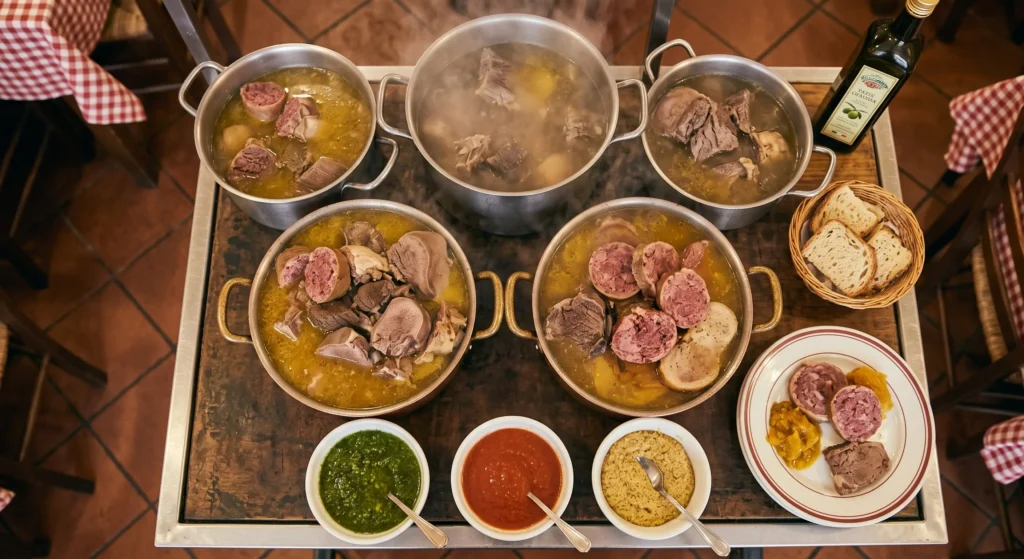
Image generated with artificial intelligence.
5. The Real Etiquette: Seven Unwritten Rules
Nobody has ever officially codified them, but in an Emilian trattoria you can spot them immediately by watching the locals.
One. The meat stays in the broth until the very last moment. Bollito left waiting on a platter dries out within minutes. If the trolley is not steaming when it arrives, something is wrong.
Two. Start with the leaner, more delicate cuts — hen, beef brisket — and work your way up to the more intensely flavoured ones: cappello del prete, tongue, zampone. Do it the other way around and your palate will quickly become saturated, making the subtler cuts harder to appreciate.
Three. Go easy on the sauce. It should accompany the meat, not cover it. Think of it as a veil, not a blanket — otherwise you might as well have ordered something else.
Four. Ask for seconds. The trolley comes around more than once, and that is exactly how it is supposed to work. Loading your plate on the first round is a beginner’s mistake: take a little, taste it, then decide what you want more of.
Five. The coarse salt on the table is not a mistake. Many trattorias serve it separately: boiled meat is deliberately lightly seasoned because the salt has gone into the broth. Adding a pinch will offend no one.
Six. Don’t ask for bread to mop up the cooking broth. In Emilia, the broth has already had its moment — in the course before the meat.
Seven. Don’t rush. Bollito is a dish for a two-hour meal around the table. If you have a train to catch, order something else.
6. What to Drink with Bollito
Bollito is rich, salty and persistent: it needs a wine that cleanses the palate rather than adding more weight.
Dry Lambrusco — the most Emilian choice and, frankly, the most effective. Lambrusco’s bubbles and acidity refresh the palate between one cut and the next. A Grasparossa can stand up particularly well to zampone and cotechino.
Gutturnio — on the Piacenza side, the local sparkling red has accompanied bollito for generations. The principle is the same, but with a slightly more tannic character.
A surprise: a dry sparkling Malvasia dei Colli di Parma works better than you might expect, especially with the more delicate cuts and with picaia. It is not the classic pairing, but no wine bar in Parma will raise an eyebrow.
7. When and Where: Bollito Is a Seasonal Dish
Bollito misto is winter food, and not merely by convention: it requires hours over a hot stove, is served piping hot, and is satisfying in a way that would be almost unthinkable in summer. The season generally runs from November to March, peaking between Christmas and New Year, when zampone and cotechino become almost a civic obligation.
Look for it in historic trattorias rather than trendy restaurants: this is a dish that requires a kitchen willing to dedicate a burner to it for half a day. The right sign is the trolley. If your bollito arrives already plated from the kitchen, it may still be excellent — but the ritual is another thing entirely.
One practical warning: many trattorias serve bollito only on certain days of the week, and some prepare it only by reservation. Call ahead. In winter, the best trattorias can run out.
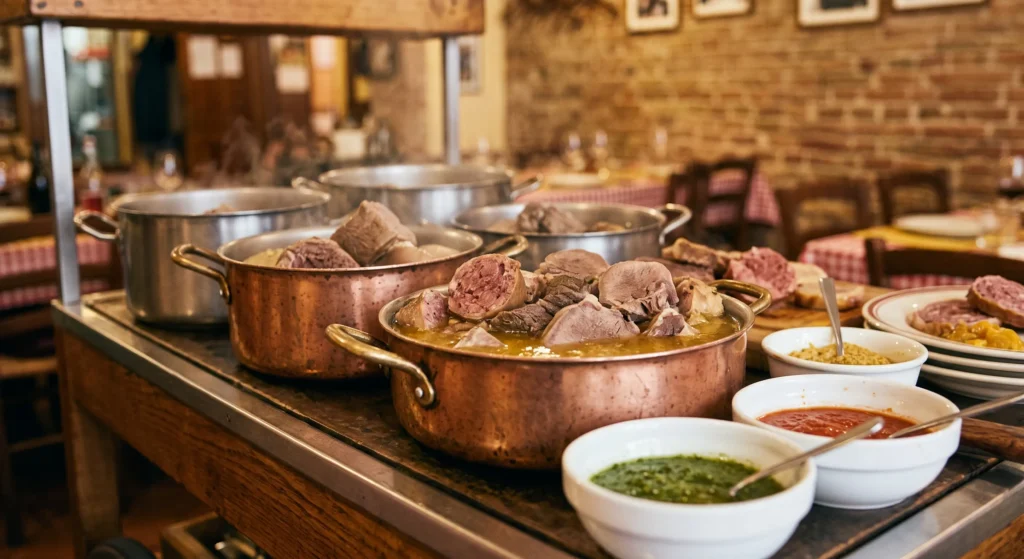
Image generated with artificial intelligence.
8. Experience Bollito with Food Valley Travel
Bollito is not a dish to sample in passing: it is part of Emilia’s dining culture, and it is best understood with someone who knows how to explain it. Food Valley Travel offers experiences that take you inside the trattorias and kitchens where this tradition is still very much alive.
→ Forks & Fun! – Cook with a Local — a cooking class with a local cook: the most direct way to understand the logic of broth, meats and sauces from the inside — and to take home a technique, not just a memory.
→ Almost Local – Food Tour in the Heart of Parma — a walking tour through Parma’s food shops and trattorias, in the homeland of cappello del prete and picaia. In winter, the perfect setting to end the day around a steaming bollito trolley.
→ Almost Local – Food Tour in the Heart of Piacenza — in the Piacenza area, where the traditions of third-degree and fourth-degree broths survive and bollito is paired with Gutturnio.
→ Almost Local – Food Tour in the Heart of Modena — the home of zampone and cotechino, the two specialities without which an Emilian bollito trolley would hardly be complete.
The Dish You Cannot Rush to Understand
Bollito misto is the opposite of almost everything contemporary cuisine celebrates: it is not photogenic, it is not light, it cannot be prepared in twenty minutes, and it is not meant to be eaten alone. It is a dish built around one simple idea — that time, applied to honest ingredients, produces something no shortcut can replicate.
The next time you spend a winter in the Food Valley, look for a trattoria with a bollito trolley. Sit down, start with a bowl of broth and anolini, then let the meat come to you. Don’t rush, take a little at a time, and try each cut with a different sauce. That is how you eat Emilia’s slowest dish.
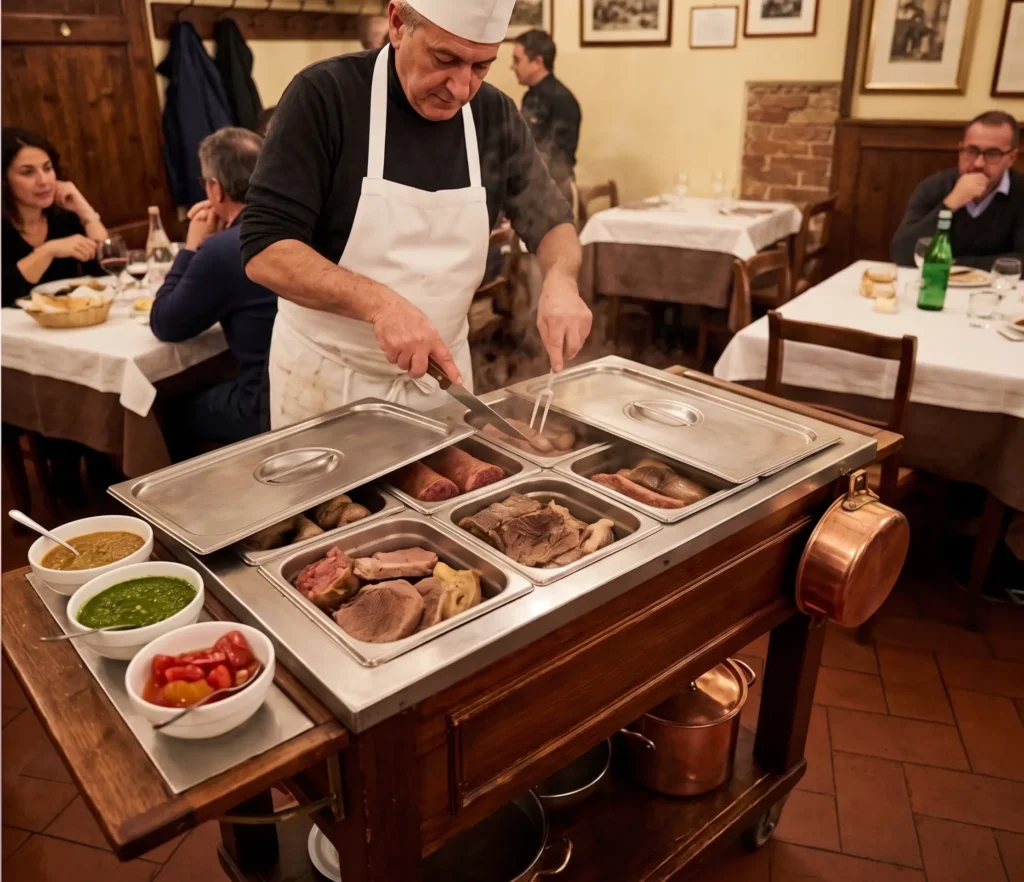
Image generated with artificial intelligence.