

Let’s say it right away: if your last experience with Lambrusco was a sweetish bottle bought at the supermarket for less than three euros, then you have never truly tasted Lambrusco. What you drank was an industrial product, designed to please everyone and offend no one — which, in the world of wine, is the same as saying absolutely nothing.
Real Lambrusco — the dry, ancestral kind, made by winemakers who treat their vines like a family legacy — is something else entirely. It is a sparkling red wine with such a distinctive personality that, in recent years, it has conquered some of the most demanding wine bars in the world, from New York to London, from Copenhagen to Tokyo. A comeback that feels like poetic justice: Italy’s most mistreated wine has become one of its most desired. And the best way to discover it is to come and look for it directly in the Food Valley.
“Lambrusco has not come back into fashion. The world has simply finally understood what Emilians have always known: that this wine, when made well, is one of the greatest pleasures of the table.”
1. Not One Lambrusco, but an Entire Family
The first misconception to clear up is the idea that Lambrusco is a single wine. It is a family — and quite a large one. Under the name “Lambrusco” live at least eleven distinct grape varieties, each with its own character, its own territory, and its own way of expressing itself in the glass. The three main ones, the ones you absolutely need to know, are Sorbara, Grasparossa, and Salamino.
Lambrusco di Sorbara: the finest and most elegant of the family. It grows on the alluvial plain between the Secchia and Panaro rivers, around the village of the same name in the province of Modena. Its color is surprisingly pale — almost rosé — with an unmistakable aroma of violet, wild strawberries, and rose petals. The acidity is sharp, almost nervous, and the body is light. Nicknamed “the Lambrusco of violets,” it is the sommeliers’ favorite and the furthest from the stereotypical image of sweet Lambrusco. It has a unique peculiarity: acinellatura, a floral anomaly that keeps the berries very small, reducing yield but concentrating quality.
Lambrusco Grasparossa di Castelvetro: the complete opposite of Sorbara in character. It comes from the hills around Castelvetro di Modena and takes its name from the red color that the leaves and stems take on in autumn. It is dark, tannic, robust, with aromas of plum, cherry, chocolate, and undergrowth. It is the Lambrusco that most surprises those who do not know the category: structured, complex, capable of aging. The denomination is considered the most prestigious among Lambrusco wines.
Lambrusco Salamino di Santa Croce: the mediator of the family. Grown in the lower Modena plain around Carpi, it takes its name from the elongated shape of its clusters, which resemble a small salami. It is the perfect synthesis of Sorbara and Grasparossa: tannins that are present but not aggressive, lively yet refined acidity, and fruity, fragrant aromas. If you have never tasted a serious Lambrusco, Salamino is the ideal starting point.
Alongside these three, there are Lambrusco Maestri, grown in the Parma area and known for being intense and dark, Reggiano, Mantovano, and several minor varieties. A level of complexity that no other wine region in the world can replicate with a single grape family.
2. A Brief History of a Great Misunderstanding
To understand the rebirth of Lambrusco, you need to understand its fall. And that fall has a precise name: the American boom of the 1980s.
In the 1970s and 1980s, Lambrusco became the most exported Italian wine to the United States — at one point, it accounted for around half of all Italian wine imported into the country. But the Lambrusco that reached America was a sweet, industrial version, produced in huge volumes using the Charmat method and designed for a palate looking for freshness and simplicity, not complexity. It was an enormous commercial success and a reputational disaster.
In Italy, Lambrusco became synonymous with “cheap wine”: the kind you drink at village festivals, the kind that costs less than mineral water, the kind critics dismissed without even tasting. And yet, while the world was looking elsewhere, a generation of stubborn winemakers kept making Lambrusco the way it had once been made: spontaneous fermentation, ancestral method, low yields, zero compromises.
“The industry almost killed Lambrusco in the 1980s. The farmers who kept making it like their grandparents did saved it. And now the world has noticed.”
3. The Ancestral Method: When Lambrusco Meets Natural Wine
The real revolution of contemporary Lambrusco has a technical name that sounds ancient: ancestral method. It is the oldest and simplest way of making sparkling wine: the must ferments once, then is bottled while it still contains residual sugars and live yeasts, and fermentation starts again spontaneously in the bottle when spring arrives and temperatures rise. No autoclaves, no added yeasts, no dosage. Just grapes, time, and temperature.
The result is a cloudy wine — often with sediment — lively, unpredictable, with a fine and persistent foam and a character that changes from vintage to vintage, from vineyard to vineyard, from bottle to bottle. It is exactly what the natural wine market loves: authenticity, terroir, controlled imperfection.
Not surprisingly, many of the producers who have led Lambrusco’s rebirth come from the world of natural or biodynamic wine. Wineries such as Cantina della Volta, Podere il Saliceto, Vittorio Graziano, Ca’ de Noci, and Lini 910 have become international references, appearing on the wine lists of Michelin-starred restaurants and avant-garde wine bars. Ancestral Lambrusco is the new Champagne of the rebels — and it costs a fraction of the price.
4. How to Drink Lambrusco — Properly
Forget everything you think you know about pairings. Dry Lambrusco is one of the most versatile wines at the table — and the reason is simple: its lively acidity and bubbles cleanse the palate between bites, exactly as Champagne or Riesling do. Only Lambrusco does it with a smile.
Temperature: serve it chilled, between 8 and 12°C. Never at room temperature, never ice-cold. Sorbara can be served cooler, around 8–10°C, while Grasparossa can be slightly warmer, around 10–12°C, to bring out its structure.
With cured meats: the classic Emilian pairing. The tannins of Grasparossa cut through the fat of Prosciutto di Parma and coppa. The acidity of Sorbara balances the savoriness of culatello. Salamino adapts to the entire charcuterie board.
With Emilian street food: tigelle, gnocco fritto, torta fritta — Lambrusco is the natural companion. The sparkle cuts through the richness, and the lightness invites the next bite. This is why, in Emilia, no one orders beer with tigelle: Lambrusco does that job better.
With pasta dishes: tortellini in broth, lasagna, Bolognese ragù, risottos — rich dishes that need a wine that does not add weight but lightens them. Even with a plate of anolini in broth, Lambrusco is the perfect Emilian answer.
A surprise: dry Lambrusco also works beautifully with Asian cuisine, sushi, and spicy dishes. Its acidity, low alcohol, and bubbles make it perfect where many structured reds would fail.
The ultimate pairing: a shard of aged Parmigiano Reggiano with a few drops of Traditional Balsamic Vinegar and a glass of dry Grasparossa. Three products born within 50 km of one another, forming together one of Italy’s most extraordinary gastronomic combinations.
“In Emilia, Lambrusco is not paired with food. Food is paired with Lambrusco. It has always been the center of the table — the world simply took a little longer to understand it.”
5. The Four DOCs to Know
To find your way around the world of Lambrusco, you need at least four reference points. Each DOC corresponds to a different grape variety, territory, and style.
Lambrusco di Sorbara DOC: the Modena plain between the Secchia and Panaro rivers. Pale color, pronounced acidity, violet aromas. The most elegant. Also produced as a traditional-method sparkling wine.
Lambrusco Grasparossa di Castelvetro DOC: the Modena hills around Castelvetro. The most structured and tannic. Intense color, aromas of dark fruit. The DOC considered the finest.
Lambrusco Salamino di Santa Croce DOC: the lower Modena plain, around Carpi. Balanced, fruity, accessible. The perfect entry point.
Lambrusco Reggiano DOC: province of Reggio Emilia. Includes several varieties. Often found in semi-sweet or sweet versions, but the dry versions from artisanal producers deserve attention.
Alongside these, there is Lambrusco di Parma IGP, based on the Maestri grape, dark and full-bodied, and Colli di Scandiano e di Canossa DOC in the Reggio Emilia area. The map of Lambrusco is as large as the Food Valley itself.
6. Experiencing Lambrusco in the Food Valley with Food Valley Travel
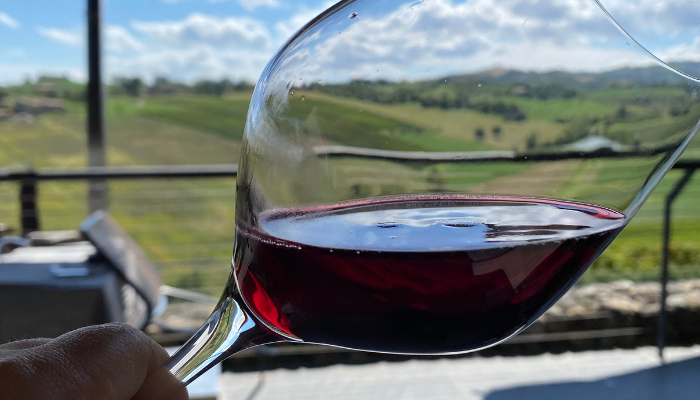
Reading about Lambrusco is one thing. Standing in a winery in the Modena Apennines, with a glass of ancestral Grasparossa in your hand, the rows of vines turning red in the late October afternoon, and a winemaker telling you how his grandfather made the same wine in the same place sixty years ago — that is something else entirely.
Food Valley Travel has created tailor-made experiences that integrate the discovery of Lambrusco into the broader context of Emilian gastronomic culture. Because Lambrusco cannot be understood on its own: it is understood at the table, with cured meats, cheeses, and the right people beside you.
→ Parmigiano-Reggiano, Balsamico & Lambrusco Tour – the perfect trio: dairy, vinegar loft, and winery in a single day. The best way to understand how Parmigiano, Balsamic Vinegar, and Lambrusco are three chapters of the same story.
→ Food Valley Gourmet Tour – The Big Fives (Full Immersion Day) – a full day among the five symbolic products of the Food Valley, Lambrusco included. For those who want the complete map.
→ Almost Local Modena Downtown Foodie Tour – Modena is the capital of Lambrusco. This walking tour crosses the city with stops in wine bars and traditional food shops where Lambrusco plays an everyday starring role.
→ Almost Local Parma Downtown Foodie Tour – in Parma, Lambrusco Maestri accompanies tigelle and cured meats in historic bars. A tour to discover the Parma side of sparkling red wine.
“Bringing home a bottle of ancestral Lambrusco bought directly at the winery, with the winemaker’s story still fresh in your memory, is the kind of souvenir you open while telling a story — and one that makes you want to travel again.”
The Wine That No Longer Needs Excuses
Lambrusco no longer needs to be “rehabilitated.” The winemakers have already done that with their work, sommeliers with their wine lists, and millions of people who have discovered that a sparkling red wine — fresh, dry, and full of character — was exactly what their table was missing.
The next time someone asks you, “But is Lambrusco a serious wine?”, answer with a glass. A Sorbara with the scent of violet, a Grasparossa with the structure of an important red, a cloudy ancestral wine that tastes of vineyard and time. And let the wine speak for itself.