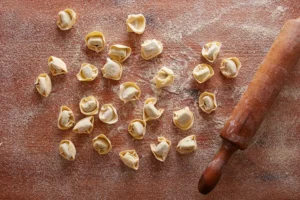

In Emilia, Christmas does not begin with the Christmas tree. It begins on December 23, when a sheet of thin, golden pasta appears on the kitchen table and three generations of the same family gather around it with one very specific task: folding a few thousand tortellini, one by one, before the day is over.
It is a long, repetitive and strangely enjoyable job. After the first fifty, your hands seem to know what to do by themselves. People chat and argue, children are promoted from spectators to workers and then demoted again when their tortellini fall apart during cooking. By the end, entire trays are covered with stuffed pasta and there is the unmistakable feeling that the celebration has already begun.
This is the story of that ritual – and everything behind it: a recipe officially registered before a notary, a medieval war, a naked goddess and a rivalry between two cities that will probably never be settled.
“Tortellini are not simply something you cook. They are something you gather people for: you need company, you need time, and you need someone who still knows how to roll pasta by hand.”
1. Venus’s Navel: The Most Famous Legend in Italian Cuisine
The true origins of tortellini are lost somewhere in the Middle Ages. But the story everyone tells is quite different, and it is worth knowing because it says a great deal about Emilia and its character.
It begins with La Secchia Rapita (The Stolen Bucket), the mock-heroic poem by Modenese writer Alessandro Tassoni. Written in the 1610s and published in Italy in 1624, it tells the story of the war between Bologna and Modena which, according to tradition, broke out over the theft of a wooden bucket. The poem already mentions tortelletti among the goods found in the disputed countryside.
The rest of the story was added by Bolognese writer Giuseppe Ceri, who between the late 19th and early 20th centuries wrote the poem L’ombelico di Venere – The Navel of Venus. In his version, Venus, Mars and Bacchus descend from Mount Olympus to help the Modenese and spend the night at an inn in Castelfranco. The following morning, Venus wakes up alone after her two companions have disappeared and calls for the innkeeper. He finds her half-naked and is completely captivated – not by the rest of her body, but by her navel. He rushes into the kitchen, rolls out a sheet of pasta and recreates its shape, filling it with meat because pasta alone simply would not do.
The detail everyone can agree on: the inn in the legend is in Castelfranco Emilia, a town that once belonged to Bologna and today is part of the province of Modena. However you choose to tell the story, everybody gets something.
The variations: Bolognese writer Vittorio Leonesi replaced Venus with Helen of Troy. In the dialect comedy Quell ch’ha inventà i turtlein, first performed in 1925, the protagonist is a cook called Pirulein who is caught in his mistress’s bed. One detail remains constant in every version: a woman’s navel and a man in the kitchen.
2. The Official Recipe: When Tortellini Went to the Notary
During the 20th century, the rivalry between Bologna and Modena over the birthplace of tortellini returned to the pages of the newspapers. A group of Bolognese food enthusiasts – particularly industrialist Giovanni Poggi – founded the Dotta Confraternita del Tortellino, adopting the motto “In studio, in mensa, Bononia docet” – Bologna teaches both in study and at the table.
The Confraternity decided to settle the matter in the most Emilian way possible: with a notarized document. First, it organized a competition among readers of the Resto del Carlino newspaper to collect family recipes from across the region. The recipe eventually selected belonged to Maria Lanzoni Grimaldi, born in Borgo Panigale. Then, on December 7, 1974, together with the Italian Academy of Cuisine, the Confraternity officially registered the authentic tortellino filling recipe with the Bologna Chamber of Commerce. Among the signatories were the Prefect and the then Mayor of Bologna, Renato Zangheri.
The officially registered filling: pork loin, prosciutto crudo, Bologna mortadella, Parmigiano Reggiano, eggs and nutmeg. The pork loin must be browned rather than used raw – one of the details that had been debated for decades. The mixture must then rest for at least 24 hours before being used.
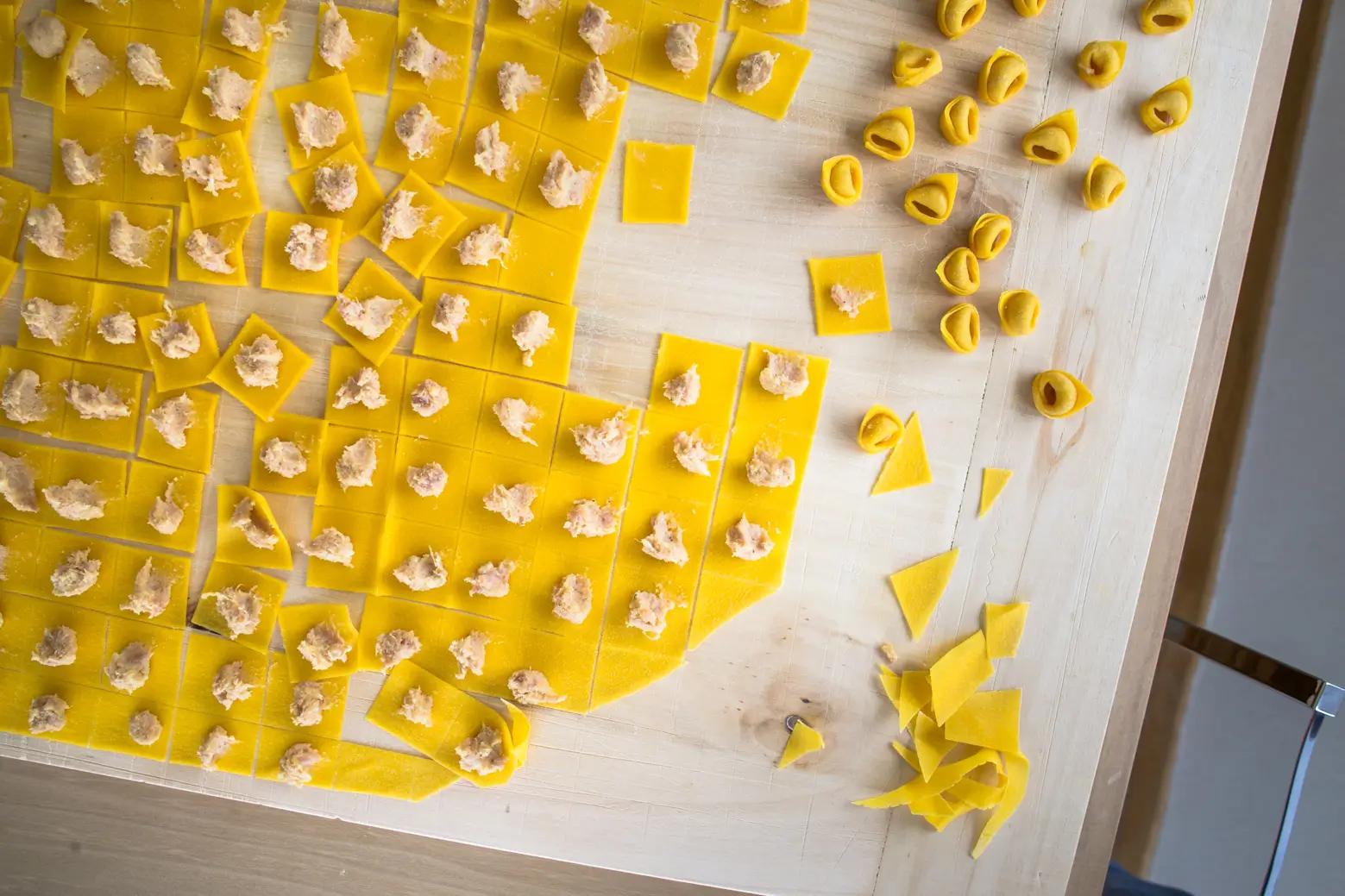
The second registration: in 2008, the Confraternity returned to the notary, this time to establish the pasta sheet, shape and dimensions. Each tortellino should weigh approximately five grams, with the filling placed in the center of a square of pasta measuring 4–4.5 centimeters on each side.
To put five grams into perspective: for a table of ten people, several hundred tortellini are needed. And that is why the family is summoned on December 23.
“Nobody has ever claimed that the officially registered recipe is the only possible one. It was chosen because, at the time, it was considered the best – which, in Emilia, is an elegant way of saying that the argument remains open.”
3. The Broth: The Invisible Half of the Dish
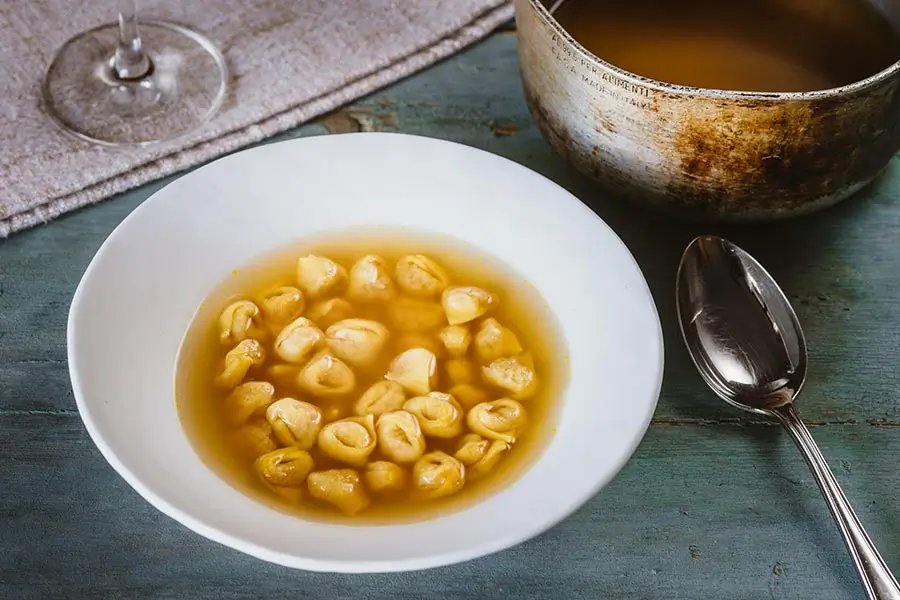
Everyone talks about the filling and almost nobody talks about the broth. That is a mistake. A perfect tortellino served in mediocre broth becomes a mediocre dish. In its 1974 document, the Confraternity established this part of the recipe too: the broth should be made with beef and free-range hen.
At home, however, Christmas often sees the hen replaced by capon: richer, fattier and better suited to a festive meal. As early as the mid-15th century, Maestro Martino wrote in his De Arte Coquinaria that capon broth was the ideal cooking liquid for the stuffed pasta that should be “no larger than half a chestnut.” Families still disagree over which version is correct – just as they disagree about almost everything else.
The connection that few people make: once the broth is ready, the pot contains several kilos of boiled meat. Nothing is wasted. That meat becomes bollito misto, the traditional second course of an Emilian Christmas lunch. The first course of pasta in broth and the second course of boiled meat are not really two separate dishes. They are two results of the same work.
4. The Folding Ritual: How It Really Works
In families that still follow the tradition, the sequence is almost always the same.
The day before: the filling is prepared and left to rest. Twenty-four hours is not an affectation – it gives the flavors time to blend.
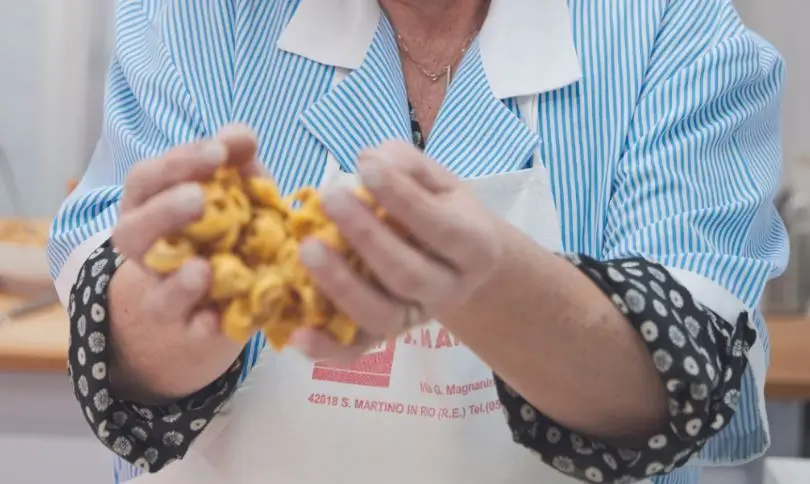
In the morning: the pasta is rolled out. This is the part that cannot be improvised: flour, eggs, a rolling pin and a sheet of pasta thin enough to almost see your hand through it. The sfoglina – traditionally a woman and often the oldest in the family – is the person who determines whether the day will be a success.
In the afternoon: the pasta sheet is cut into squares, the filling is added and the tortellini are folded. The movement is precise. The square is folded into a triangle, the edges are sealed, the pasta is wrapped around a finger and the two ends are joined. Someone who has been doing it for thirty years can close a tortellino every few seconds. Someone trying it for the first time will probably ruin the first twenty.
Drying: the tortellini are laid out on a cotton cloth without touching each other, otherwise they stick together. After about an hour, they can be cooked, refrigerated or frozen.
The truth about the ritual: nobody actually needs to make three thousand tortellini by hand. You can buy them almost everywhere, and they are good. Families continue making them because it is perhaps the only time of the year when everyone sits in the same room for six hours doing exactly the same thing. The dish itself is almost a side effect.
5. Bologna, Modena and the Rest of Emilia
The historic dispute is between Bologna and Modena, and it is far from settled. Bologna points to the official recipe and the Confraternity. Modena points to Castelfranco, the legend and Tassoni. The practical result is that at Christmas both cities eat the same dish while insisting that it belongs to them.
But Emilia’s festive stuffed-pasta map extends much further. In Parma and Piacenza, the traditional Christmas dish is not tortellini but anolini in broth: smaller, round and made with a completely different filling. The ritual of making them, however, is almost identical, although wooden cutters replace the fingers used to shape tortellini. In Romagna, there are cappelletti. Different provinces, different pasta shapes, but the same scene around the kitchen table on December 23.
“In Bologna, turtén; in Modena, tortellini; in Parma, anolini; in Romagna, cappelletti. Four names for the same idea: that the right way to celebrate is to spend an entire day preparing the following day’s lunch.”
6. Mistakes to Avoid – According to the Emilians
Cream. Tortellini with cream do exist. They were created by the famous Bolognese cook Cesarina, although she used cream skimmed directly from freshly milked milk. Industrial cream produces a very different result: the filling disappears beneath a white blanket instead of being enhanced by the broth. At Christmas in Emilia, tortellini belong in broth. Period.
Stock cubes. They undo hours of work spent preparing the pasta and filling. If there is not enough time to make both, buy the tortellini and spend the time making a proper broth.
Oversized tortellini. Five grams. A ten-gram tortellino has a completely different pasta-to-filling ratio and feels different in the mouth. Here, size is not about appearance. It is part of the recipe.
Grated Parmigiano on top. Even Emilians argue about this one, so some caution is required. Parmigiano Reggiano is already part of the filling, and many believe that adding more to the broth overwhelms everything else. Before reaching for the cheese, see what everyone else at the table is doing.
What to drink: a dry Lambrusco is perhaps the most Emilian choice. It works with hot broth much better than you might imagine and prepares the palate for the bollito that follows.
7. Experience an Emilian Christmas with Food Valley Travel
The tortellino ritual belongs to families, and families are not tourist attractions. The technique, however, can be shared – and in just a few hours it can be learned from the people who still practice it. Food Valley Travel offers experiences that take guests into the kitchens and cities where this tradition was born.
→ Forks & Fun! – Cook With a Local! – a cooking class with a local cook: roll the pasta, learn how to fold it and take home a gesture rather than a written recipe. The only serious way to understand the ritual from the inside.
→ Almost Local Bologna Downtown Foodie Tour – the home of the Dotta Confraternita and the officially registered recipe, where traditional pasta makers can still be seen rolling and shaping fresh pasta in shop windows.
→ Almost Local Modena Downtown Foodie Tour – the other side of the argument: Castelfranco, the legend of Venus and a tradition that Modenese people defend just as passionately as their Bolognese neighbors.
→ Parmigiano-Reggiano – The One & Only – Parmigiano is found in the filling of all four of Emilia’s traditional stuffed pastas. Seeing where it comes from helps explain why the right maturation makes such a difference to the final dish.
When to come: Christmas is undoubtedly the most evocative time, but it is also the busiest period and many businesses close for the holidays. November and the first half of December offer much of the same atmosphere, with greater availability – and the same broth waiting in the local trattorias.
The Day Before the Celebration
A tortellino is a tiny object around which centuries of stories have accumulated: a war over a bucket, a mock-heroic poem, a goddess discovered in an inn, a notarized recipe and a rivalry between two cities that will probably never end. But the thing that really matters cannot be found in any of those documents.
What matters is December 23. The table. The hands. The hours passing without anyone looking at their phone. Everyone in Emilia knows it, even if nobody says it: Christmas lunch is wonderful. But the day before is even better.