

Serious question, serious answer: yes. In the Bassa Parmense, the lowlands north of Parma, fog is not simply a weather inconvenience to endure between November and February. It is a production condition. Without that fog — dense, persistent, rising from the Po and lingering for weeks — Culatello di Zibello PDO simply would not exist.
It is a technical fact before it is a poetic one, and it explains why this stretch of flatland between Parma and the great river is such a special place: a territory that has turned its most inconvenient climatic condition into one of its greatest assets. And one that, perhaps not by chance, also produced one of the most distinctive literary perspectives of 20th-century Italy.
“It’s a rough strip of land where winter fog erases everything and the summer heat cooks your thoughts. It isn’t a beautiful place. It’s a place that stays with you.”
1. The Mondo Piccolo: Where Guareschi’s Vision Was Born
Giovannino Guareschi was born in Fontanelle di Roccabianca on May 1, 1908, in the middle of the plains that follow the course of the Po, halfway between Parma and Cremona. He studied in Parma, where he met Cesare Zavattini — just six years his senior, already an editor, and a decisive influence on his development. He began as a satirical illustrator and went on to become one of the most widely read Italian writers of all time with his Mondo Piccolo stories.
The Mondo Piccolo is the Bassa: an unnamed village on the plains where the parish priest Don Camillo and the communist mayor Peppone fight and help each other in a delicate balance that neither would ever admit to. Guareschi describes it as that stretch of land between the Po and the Apennines where the fog weighs heavily in winter and the sun beats down in summer — and where, perhaps precisely because of this, passions erupt with an intensity rarely found elsewhere.
The real-life inspirations: Don Camillo was inspired by Don Ottorino Davighi, parish priest of Polesine Parmense after the war. Peppone was inspired by Giovanni Faraboli, a trade unionist and town councillor from Roccabianca who was forced into exile by Fascism and died in Parma in 1953. Two real people, two lives separated by just a few kilometres.
Brescello, the film set: in the five films starring Fernandel and Gino Cervi, Brescello, on the Reggio Emilia side of the Po, played the role of the village. Since then, it has been known as “the village of Don Camillo”, and its railway station has remained virtually identical to the one seen on screen.
Guareschi died in Cervia on July 22, 1968, at the age of sixty. He had spent the last fifteen years of his life in Roncole Verdi, a hamlet of Busseto — the same village where Giuseppe Verdi was born. Two of Emilia’s most famous figures, born and buried within the same tiny cluster of villages.
2. How Fog Becomes Flavour: Culatello di Zibello
Back to our original question. Here is why fog is, technically, an ingredient.
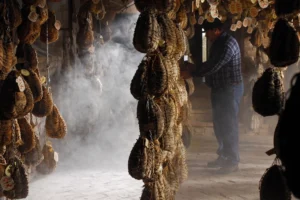
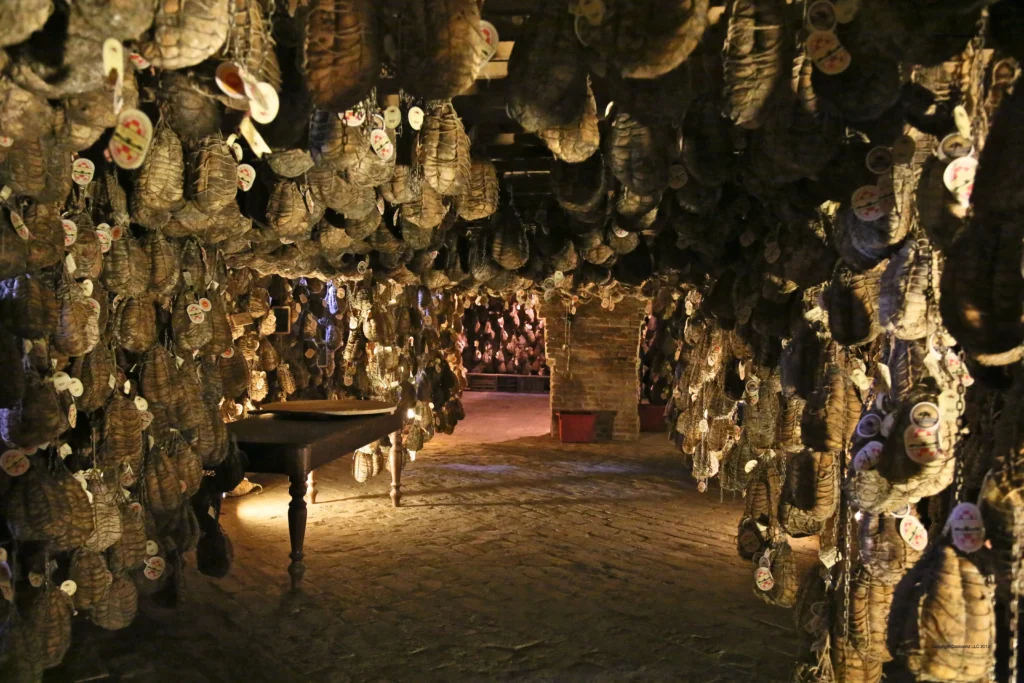
From October to February, the proximity of the Po generates persistent fog that keeps the relative humidity in the ageing cellars extremely high and, above all, constant. These are the conditions that allow a cured meat without bone or rind — and therefore much more exposed — to mature slowly without drying out too quickly. Then comes the hot, humid summer of the Po Valley, completing the cycle by gradually drying the product. No other area of Italy can replicate this same alternation.
The process: Culatello is made exclusively from the rear and most prized part of the pork leg — the noce and fiocco — with the bone and rind removed. After salting comes the investitura: the meat is encased in a pig’s bladder and hand-tied with string into its characteristic pear shape. By the end of the ageing process, the string must form a wide, irregular mesh. Then it goes down into the cellar — ancient, non-climate-controlled cellars, with windows opening towards the river to let the fog in.
The timing: production traditionally begins between October and February, when the cold and humidity are ideal. Ageing takes the Culatello from the winter fog through the humid summer heat and can last from 12 to 36 months. A Culatello placed in the cellar this winter will not reach the table until, at the very earliest, the following winter.
The PDO production area: the regulations restrict production to eight historic municipalities of the Bassa Parmense — Zibello, Polesine Parmense, Busseto, Soragna, Roccabianca, San Secondo Parmense, Sissa and Colorno. Today, following administrative mergers that combined Zibello with Polesine Parmense and Sissa with Trecasali, the number of municipalities shown on the map is seven. This is why both figures can still be found. The production area itself, however, has not changed.
“Parma Ham is made by the wind descending from the Apennines. Culatello is made by the fog rising from the river. The same province, two opposite climates, two masterpieces.”
The contrast with Prosciutto di Parma is particularly striking: both come from the same province, but one needs the dry air of the hills while the other depends on the humidity of the plains. That is why, in just an hour’s drive, you can travel from one microclimate to another — and from one extraordinary cured meat to another.
3. The Itinerary: The Places of the Mondo Piccolo
The Bassa can easily be explored over a weekend, by car or by bicycle. It is flat, lightly trafficked and full of detours worth taking. These are the stops that bring together literature, cinema and the local tradition of cured meats.
Fontanelle di Roccabianca — Guareschi’s birthplace. A handful of houses surrounded by fields, with the distinct feeling of having arrived at the place where everything else began.
Roccabianca — home to the castle built by Pier Maria Rossi for Bianca Pellegrini, with its Sala di Griselda. Culatelli still mature in the cellars of the castle keep: literature, castle history and cured meats all under the same roof.
Diolo di Soragna — home to the Centro del Boscaccio, a small museum housed in the old bell tower and born from the friendship between Guareschi and the Bertozzi family. Its name comes from podere Bosco, the farm where the writer’s paternal grandparents lived and which appears in his stories.
Roncole Verdi — a stop with two stories to tell: the birthplace of Giuseppe Verdi, a national monument and now a museum, and the permanent exhibition dedicated to Guareschi, created at the initiative of his children. The writer is buried in the village cemetery. In the Church of San Michele Arcangelo, Verdi was baptised and practised as a child on the 18th-century organ.
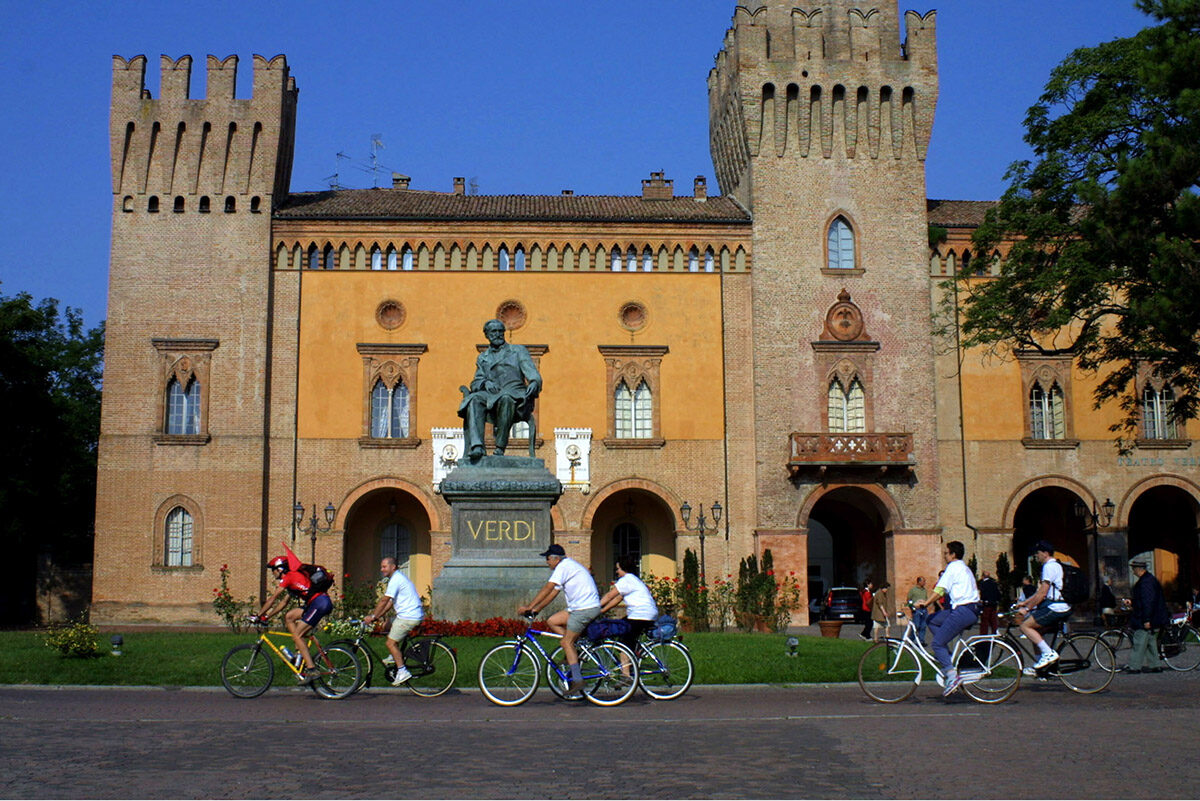
Busseto — the heart of Verdi country: the 15th-century square with its monument to the Maestro, the Rocca Pallavicino housing Teatro Verdi, the Collegiate Church of San Bartolomeo and Casa Barezzi, where the young Verdi developed both musically and romantically. The town is also home to a historic salsamenteria where there is no menu: food is served on sharing boards, with Verdi’s arias playing in the background.
Polesine Zibello — the heart of Culatello country, with its ageing cellars and Antica Corte Pallavicina overlooking the river. It is also the parish of the real-life Don Camillo.
Brescello — cross the Po and you are already in the province of Reggio Emilia, but the Mondo Piccolo knows no administrative borders. Three museums — Peppone and Don Camillo; Guareschi, the territory and cinema; and the Archaeological Museum — can be visited with a single ticket, along with the famous square that you will recognise at first glance.
Colorno — home to the Reggia di Colorno, the “Little Versailles” of the Dukes of Parma, and to ALMA, the International School of Italian Cuisine. It marks the eastern end of the Bassa and its connection with Parma.
4. The Paradox: The “Bad” Season Is the Right One
Every travel guide recommends visiting Emilia in spring or autumn. For the Bassa, the opposite is true: winter is when this territory is most authentically itself, when the fog reduces visibility to fifty metres, the river embankments disappear and church towers emerge from nowhere like islands.
It is also the season when the ageing cellars are at work, when bollito misto returns to the trolleys of traditional trattorias and when Lambrusco is at its best. Summer visitors find a hot, humid and empty landscape; winter visitors find a territory at work.
A word of caution: driving through the fog of the Bassa is not always easy. The roads are narrow, often raised along the river embankments and sometimes poorly lit. If you are not familiar with these conditions, consider travelling during the central hours of the day or joining an organised excursion with a professional driver.
5. Discover the Bassa with Food Valley Travel
The Bassa is the least signposted and perhaps the hardest part of the Food Valley to decipher: few signs, ageing cellars that cannot be visited without an appointment, and a geography that seems almost identical everywhere until someone tells you its stories. Food Valley Travel offers several experiences designed specifically around this fascinating stretch of the plains.
→ Parmigiano Reggiano & Culatello Tour – Traditions of Excellence — a day that brings together two extremes of the Food Valley: a visit to a Parmigiano Reggiano PDO dairy, followed by a journey into the heart of the Bassa, where the Po winds through the plains, to visit a Culatello di Zibello PDO ageing cellar. Lunch at a local restaurant, producer or agriturismo.
→ In the Footsteps of Giuseppe Verdi – A Journey Through the Maestro’s Life — a Verdi itinerary between Roncole and Busseto — the same places where Guareschi lived and is buried. The best way to understand just how small the Mondo Piccolo really is.
→ Fine Food & Stunning Castle – Bassa Parmense — the castles of the plains and the cured meats ageing in their cellars. A combination that explains why, in this part of Emilia, castles and Culatelli share the same historic buildings.
→ Wheels & Wonders – Food Bike Tour in the Bassa Parmense — five hours by e-bike around Busseto along the Zibello–Polesine corridor, with stops at a cheese dairy and a Culatello ageing cellar. The Bassa at exactly the right pace.
“Buying a Culatello directly from the ageing cellar on a January morning, with the fog drifting in through the window alongside you, is the kind of purchase that makes you understand exactly why it costs what it does.”
A Place That Cannot Be Captured in a Photograph
The Bassa Parmense may be the only part of the Food Valley that does not work on a postcard. It has no hills, no sweeping panoramas, no villages perched dramatically on mountaintops. Instead, it has an endless plain, a slow-moving river, narrow embankments and winter fog that erases everything — and in that very disappearance, it produces one of Italy’s most prized cured meats and some of the country’s most beloved 20th-century literature.
Guareschi used to say that things happen here that could not happen anywhere else. He was right, and not only in a literary sense: there is a cured meat to prove it. Next time you plan a trip to Emilia, save two days for the Bassa. Preferably in winter. Preferably in the fog.