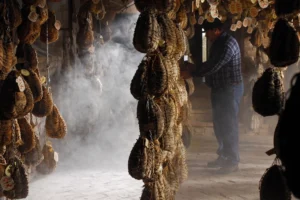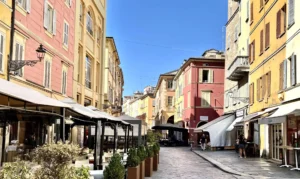


There is a moment of the day when Parma transforms. It happens around six in the evening, when the golden light of late afternoon floods the porticoes of the historic center and the shops begin pulling down their shutters. It’s aperitivo hour — and in Parma, aperitivo is not a drink: it’s an institution.
Don’t expect Milan’s nightlife scene or Roman frenzy. The Parma aperitivo is a slower ritual, more local, more rooted in the territory. You drink Malvasia dei Colli di Parma or Lambrusco, not Spritz (or at least not only). You eat torta fritta with hand-cut Prosciutto di Parma, not chips from a bag. And you chat — at length, unhurried, knowing that dinner can wait.
“Aperitivo in Parma isn’t the prelude to dinner. It’s a meal in itself, a social ritual, and often the most sincere moment of the day.”
1. The Aperitivo Trapezoid: The Map Only Parma Locals Know
If you look at a travel guide, it will tell you to go to Via Farini. It isn’t wrong — but it’s incomplete. The real aperitivo zone of Parma isn’t a street: it’s an irregular quadrilateral, a sort of trapezoid, bounded by four axes that anyone who lives in the city knows by heart.
The four sides: Strada Farini to the west, Strada della Repubblica to the north, Strada XXII Luglio to the east and Borgo Felino closing the south side. Within this perimeter — and in the alleys that cross it — almost all the venues that matter are concentrated. It’s an area you can walk in ten minutes, and at sunset it fills up until it becomes one single, very long collective aperitivo.
Strada Farini is the backbone: it starts from Piazza Garibaldi and runs south, flanked by porticoes and a density of enoteche hard to find elsewhere in Emilia. This is where most of the historic venues are concentrated, and this is where you almost always start.
A useful clarification: Strada della Repubblica works more as a boundary than a destination. It’s an important through road, but it isn’t where Parma locals sit for aperitivo. Anyone who arrives expecting nightlife there is disappointed: the real density is inside the trapezoid, not on its northern edge.
Borgo Felino and Strada XXII Luglio are the side least trodden by tourists. Narrower streets, smaller venues, less flashy signs — and for exactly that reason the right place for those who want to avoid the most crowded tables and find a more intimate atmosphere.
The ritual: in Parma aperitivo is often ordered “alla parmigiana” — a glass of sparkling Malvasia or dry Lambrusco, accompanied by a platter of cured meats and torta fritta. It isn’t a beefed-up aperitivo: it’s the condensed version of an entire gastronomic tradition in an hour of conviviality.
2. Oltretorrente: The Working-Class Soul
Cross the stream and you’re in Oltretorrente — Parma’s historic working-class neighborhood, famous for the rebellious character of its residents and for the 1922 barricades against the Fascist squads. Today it’s one of the liveliest neighborhoods in the city, with a more informal, less touristy selection of venues than the trapezoid in the center.
Here you’ll find traditional osterie with peeling walls and Lambrusco served in a carafe, new-generation wine bars offering natural and re-fermented labels, and trattorias where aperitivo blends naturally into dinner. It’s the alternative nightlife: slower, more neighborhood, more real.
Local tip: order a glass of dry Lambrusco with a small plate of ciccioli (Parma’s “ciccioli,” crunchy fragments of pork fat — a calorie bomb and a delight). And if they ask whether you want it “fred” (cold, in the local dialect), the answer is yes: Lambrusco is drunk cold, always.
3. Where to Drink: The Venues of the Trapezoid
A few concrete addresses, all inside or right next to the quadrilateral. These are venues with a history behind them, not seasonal openings — but it’s always worth checking hours and closing days before heading out, because in Parma several wine bars open only in the evening and many close one day a week.
Enoteca Tabarro (Strada Farini 5/b) — perhaps the best-known wine bar in the city, and one of the few open every day from 6:00 pm to midnight. A selection of natural and artisanal wines, platters of cured meats and cheeses, a bottega atmosphere that fills up quickly. If you arrive after 7:30 pm on the weekend, be prepared to stand.
Antica Enoteca Fontana (Strada Farini 24) — the historic institution, the place where time seems to have stopped: wooden counters, open kitchen, a coming and going of locals who walk in, drink a glass and greet everyone by name. Simple cooking and prices still honest for such a central street.
Vineria Giramondo (Strada Farini 38) — further down the same street, with a wine list that goes beyond Emilian borders and platters of selected cured meats and cheeses. Opens at 5:30 pm, closed Monday.
Bottiglia Azzurra (Borgo Felino 63) — on the southeast side of the trapezoid, where tourism arrives far less. Wine bar and trattoria in one: you begin with a glass and a platter and end, almost inevitably, with a plate of anolini in broth. Closed Sunday.
Parmamenù (Piazza Garibaldi 19/L) — at the northern vertex of the trapezoid, halfway between a delicatessen and a bar. It’s the right place for a custom-built platter, with staff explaining every product. Continuous hours, handy for those who want to start aperitivo early.
One last note: signs change, and so do owners. If an address no longer lives up to expectations, the criterion for finding your own way is simple: look at who’s inside. If the counter is full of people speaking dialect and nobody is photographing the platter, you’re in the right place.
4. What to Drink: A Guide to the Right Glass
Malvasia: the white of the territory, in its dry sparkling version. Look for labels from the Colli di Parma — names like Lamoretti or Monte delle Vigne are known and respected in the city. It’s the wine that best handles the pairing with cured meats without weighing you down.
Lambrusco: the offer is huge, but serious venues offer dry and ancestral versions. To stay in Parma territory, ask for a Lambrusco Maestri — darker and fuller-bodied than its Modenese cousins.
Spritz (yes, it exists here too): the most central bars serve it, of course. But the true Parma local considers it an acceptable option only as a second round, never as an opener. That said, there is a local variant worth trying: a spritz made with Lambrusco instead of prosecco. Darker, more tannic, with a fruity note that stands up surprisingly well to the bitterness of the bitter. You won’t find it on every menu — but if you ask for it in a venue that knows the territory, they know exactly what you’re talking about.
For those who want to explore: some enoteche offer tasting itineraries with guided pairings between local wines and PDO cured meats. It’s aperitivo elevated to a cultural experience — and the best way to understand in an hour what would otherwise take a week of visits.
5. What to Eat with Aperitivo
Parma aperitivo is not drunk on an empty stomach. Here is what you’ll find (and what you should order).
Torta fritta: puffy, golden rectangles of fried dough, to be filled with Prosciutto di Parma or Felino salami. It’s the perfect companion to Lambrusco — crunch, fat, bubbles, palate cleansing. A continuous cycle. In Parma it’s called torta fritta; in the rest of Emilia it’s gnocco fritto.
PDO cured meat platter: prosciutto crudo, coppa, Felino salami, culatello (if the venue is serious). Hand-cut, at room temperature, served with grissini or torta fritta.
Shavings of Parmigiano Reggiano: very aged, with drops of Traditional Balsamic Vinegar. A classic that never gets old.
Ciccioli: the off-menu item to order at least once. Crunchy, very salty, perfect with a cold glass. They’re not for everyone — but those who love them never let go.
“In Parma you don’t choose aperitivo from the menu. You choose it from the cured-meat counter. And the right glass comes on its own.”
6. Experiencing Parma Aperitivo with Food Valley Travel
The best way to discover Parma’s nightlife isn’t a travel guide: it’s someone who knows where to sit, what to order and why. Food Valley Travel organizes walking experiences in the historic center that include gastronomic stops in the city’s most authentic venues — the ones inside the trapezoid, not the ones in the guidebooks.
→ Almost Local Parma Downtown Foodie Tour – the tour that takes you to the shops and bars where Parma locals really have their aperitivo. No tourist traps, only real places.
→ Almost Local Bologna Downtown Foodie Tour – for those who want to compare Parma’s aperitivo with Bologna’s — two neighboring cities, two different styles.
→ Parmigiano-Reggiano, Balsamico & Lambrusco Tour – to understand what’s in the glass before drinking it at aperitivo. Visit to a dairy, an acetaia and a winery, then back to the city at the right hour.
Practical tip: aperitivo in Parma starts around 6:00 pm and ends when it ends — usually around 9:00 pm, when many people move straight to dinner. Friday and Saturday are the liveliest times, but watch the closing days: several wine bars in the center rest on Monday or Sunday. If you only have one evening, Thursday is the best compromise between crowds and available seats.
Drinking Like a Parma Local
Aperitivo in Parma can’t be explained: it’s lived. It’s the moment when the city slows down just enough to enjoy a glass, a platter and a conversation without looking at the clock. It isn’t spectacular, it isn’t Instagrammable (or at least it doesn’t try to be), and that is exactly why it works.
The next time you arrive in Parma, forget the dinner plan for the first evening. Step into the trapezoid, sit where you see locals, order a Malvasia and a plate of torta fritta, and let the city tell you what to do next.