

Why Can Prosciutto di Parma Not Be Made Anywhere Else?
Four ingredients: Italian pork, salt, air, and time. Nothing else. No preservatives, no additives, no artificial flavorings. And yet, with this ridiculously short list, Prosciutto di Parma PDO manages to be one of the most recognized and inimitable gastronomic products on the planet.
The question everyone asks — tourists, chefs, producers from other countries — is always the same: why can’t it be made elsewhere? If the ingredients are so simple, what makes Langhirano and the Parma hills the only place in the world where this prosciutto can be born? The answer is a combination of science, geography, and centuries-old stubbornness.
“Prosciutto di Parma is not made by the charcutier. It is made by the air. The charcutier is simply wise enough to open the windows at the right moment.”
1. The Air of Langhirano: The Fifth Ingredient
If there is a secret behind Prosciutto di Parma, it is called microclimate. And that microclimate has a precise address: the hills of the Parma Valley, between Langhirano and Lesignano de’ Bagni, south of the Via Emilia, at a maximum altitude of 900 meters.
Here is what happens in that strip of land. The sea breeze rises from the Versilia coast, carrying with it the humidity of the Tyrrhenian Sea and the aroma of the pine forests. When it reaches the Cisa mountains, along the Apennine watershed, it loses its saltiness and excess humidity. Then it descends through the Parma valleys, crosses the chestnut woods, and reaches the prosciutto curing facilities — dry, fragrant, with exactly the right level of humidity needed for slow and perfect aging.
This is not a romantic tale: it is thermodynamics. The convective currents between the plain and the Apennines create a constant flow of air that enters through the large windows of the curing facilities — tall, narrow windows specifically designed to channel the wind. The Master Curers open and close those windows according to the weather conditions, the season, and the internal humidity: it is a job that requires sensitivity and experience, something no air-conditioning system can replicate.
A curiosity for travelers: when visiting a prosciutto facility in the area, the first thing that strikes you is the smell. The air around Langhirano has a sweet, slightly smoky aroma that is impossible to describe and impossible to forget. It is the scent of Prosciutto di Parma as it ages — and it literally permeates the landscape.
2. The PDO Production Regulations: Rules That Protect Excellence
Prosciutto di Parma is a Protected Designation of Origin product, and its production regulations are among the strictest in the agri-food world — a rigor it shares with other champions of the Food Valley such as Parmigiano Reggiano PDO and Traditional Balsamic Vinegar PDO.
Origin of the pigs: the legs must come exclusively from pigs born and raised in eleven regions of central and northern Italy: Emilia-Romagna, Lombardy, Piedmont, Veneto, Trentino, Friuli, Marche, Umbria, Tuscany, Lazio, and Abruzzo. The permitted breeds are Large White, Landrace, and Duroc, and the animals must reach a minimum weight of 160 kg and a minimum age of 9 months.
Production area: the entire process — from salting to aging — must take place in the province of Parma, specifically in the area south of the Via Emilia, at least 5 km away from it, bordered to the east by the Enza River and to the west by the Stirone stream. A tiny, almost surgical area.
Ingredients: only pork and salt. The sugna — a mixture of pork fat, salt, and pepper used to protect the meat during aging — is considered a technological aid, not an ingredient, and is completely natural.
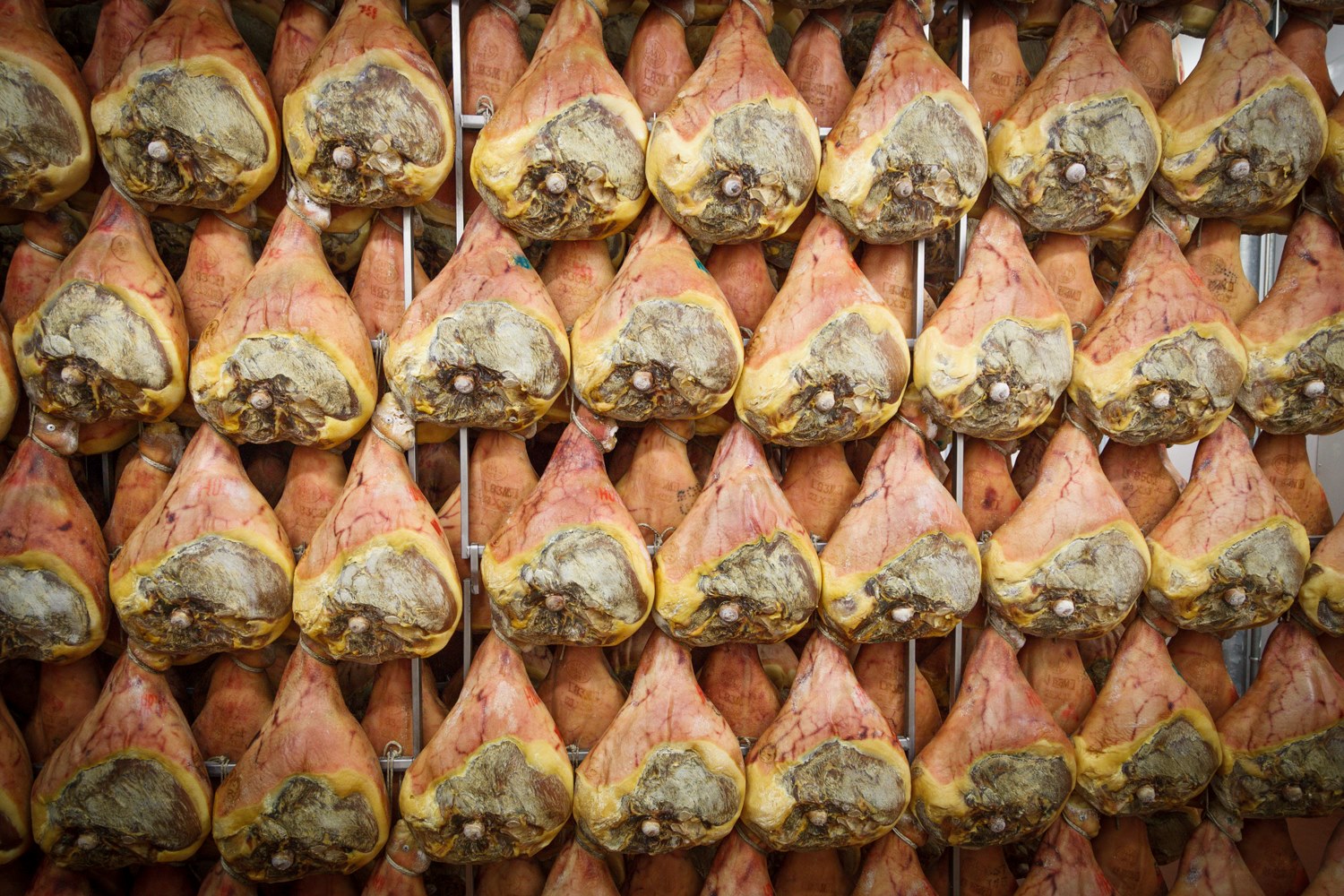
Minimum aging: 14 months from salting. However, the finest versions exceed 18, 24, or even 30 months. Only at the end of the aging period, after passing the quality inspection, does the prosciutto receive the fire-branded five-point Ducal Crown — the Consortium’s seal of authenticity.
3. The Production Stages: A Calendar of Patience
The production of Prosciutto di Parma follows a journey that lasts at least one year and allows no shortcuts.
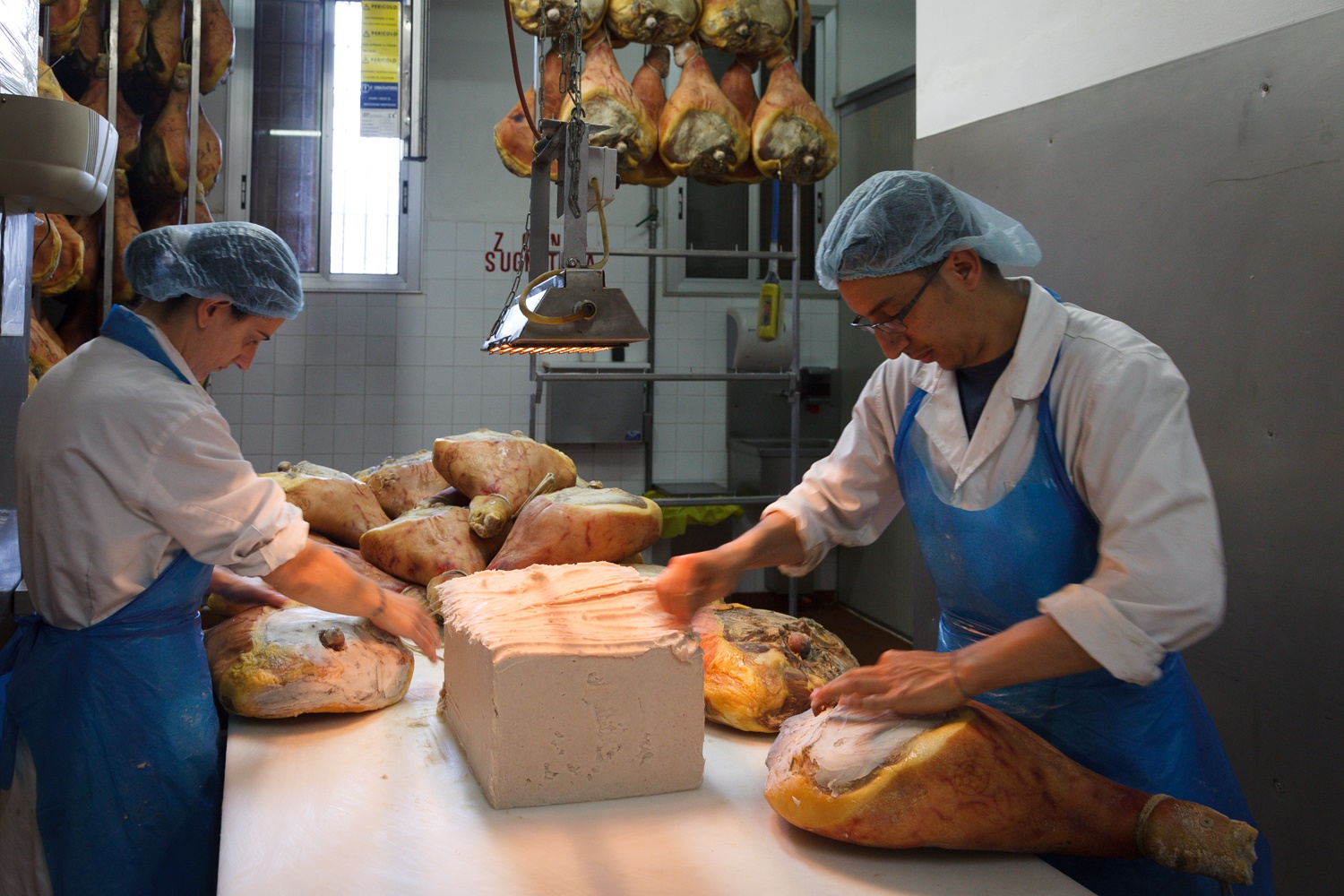
Cooling and trimming: the fresh pork legs arrive at the curing facilities and are left to rest in refrigerated rooms to stabilize their temperature. They are then trimmed: excess fat and rind are removed, giving the prosciutto its characteristic rounded and elegant shape.
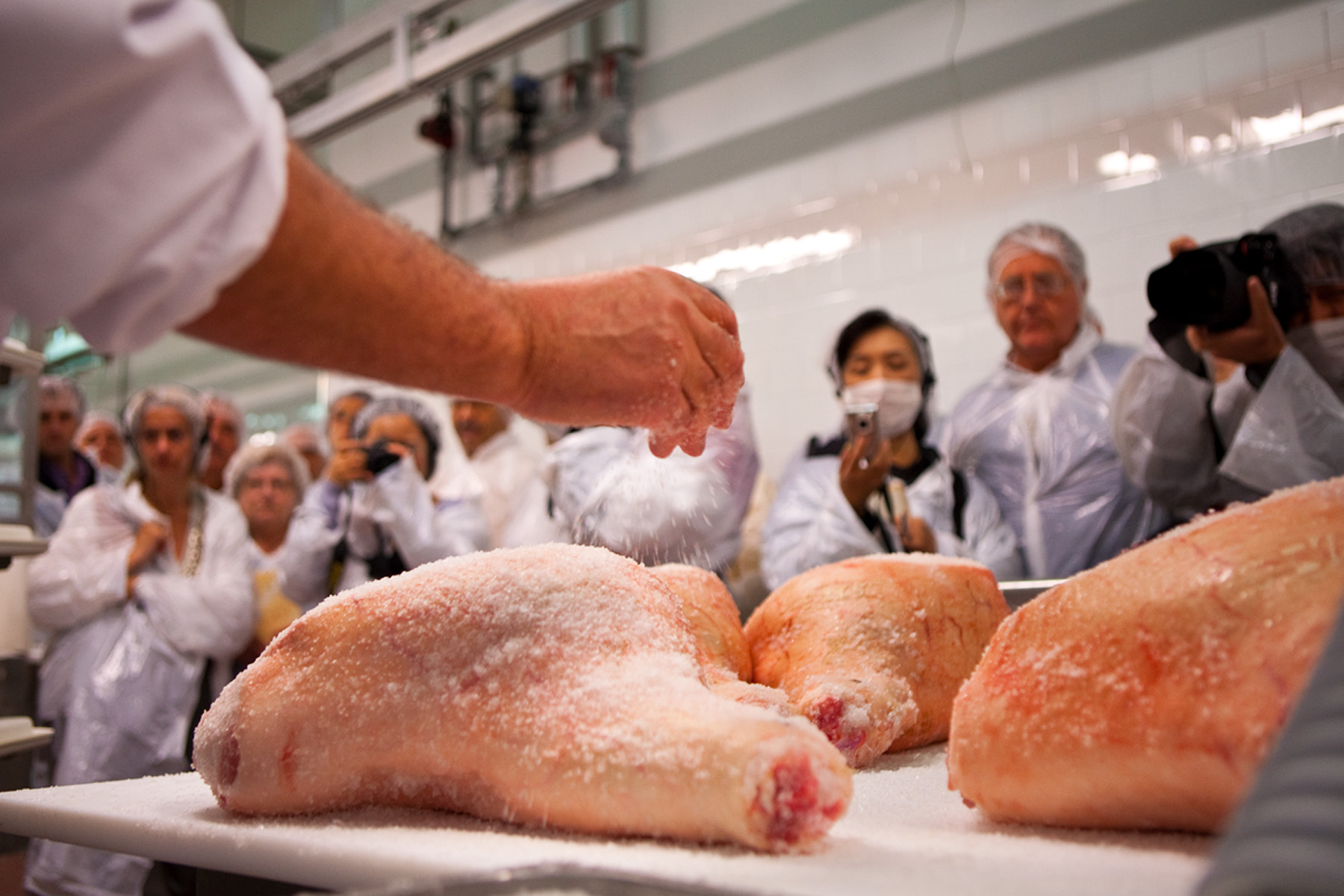
Salting: the legs are massaged with sea salt — very little, compared to other hams. The Master Salter adjusts the quantity according to the weight and thickness of the leg. Salting takes place in two stages, about a week apart, in cold rooms. This sparing use of salt is the main reason for the unique sweetness of Prosciutto di Parma.
Resting: after salting, the prosciutti rest for about 60–80 days in rooms with controlled temperature and humidity. The salt slowly penetrates the meat, distributing itself evenly.
Washing and drying: the prosciutti are washed with warm water to remove excess salt, then hung in drying rooms. Here, the work of the Langhirano air begins: the windows are opened and closed according to the conditions, using natural air currents to dry the product slowly. The weight loss during this stage is around 8–10%.
Sugna application: around the fifth or sixth month, the exposed parts of the meat are covered with sugna. Its purpose is to soften the surface layers, preventing them from drying too quickly compared to the inner parts.
Aging: in the seventh month, the prosciutti are transferred to the cellars — cooler rooms with less ventilation. This is where the biochemical processes that transform the meat take place: proteolysis breaks down proteins into free amino acids, which are responsible for taste and aroma. Tyrosine crystals — those small white formations found in more mature prosciutti — are a visible sign of this process and an indicator of quality.
Needle testing: at the end of the aging period, an inspector from the Consortium carries out the needle test: a horse-bone needle, a material that absorbs and releases aromas quickly, is inserted into different points of the leg and smelled. If the aroma is right — sweet, clean, free of defects — the prosciutto receives the Ducal Crown. Otherwise, it does not. There are no exceptions.
“The horse-bone needle is the final exam before the crown. An ancient gesture, an expert nose, and zero margin for error: if the aroma is not perfect, the prosciutto does not become Parma.”
4. The Hidden Etymology: “Prosciutto” Means “Dried”
One detail illuminates everything: the word “prosciutto” comes from the Latin “perexsuctum”, meaning “dried” or “drained.” Not salted. Not smoked. Dried. The entire identity of this product is contained in its name: it is a piece of meat that time and air have transformed into something else.
The Romans already knew this. Cato the Elder, in the 2nd century BC, described in De Agri Cultura the technique of salting pork legs practiced in Cisalpine Gaul — the area that is today Emilia-Romagna. Two thousand years later, the principle is the same: salt, air, patience. Only the bureaucracy has become more complex.
5. Prosciutto di Parma vs gli altri: cosa lo rende diverso
Italy has several outstanding PDO cured hams — San Daniele, Carpegna, Toscano, Norcia. None is “better” in absolute terms, but the differences are real and worth knowing.
Compared to San Daniele: San Daniele keeps the trotter intact, has a flatter shape because it is pressed during production, and requires a minimum aging period of 13 months. Parma tends to be sweeter and slightly more moist, while San Daniele is drier, with a slightly more pronounced aftertaste.
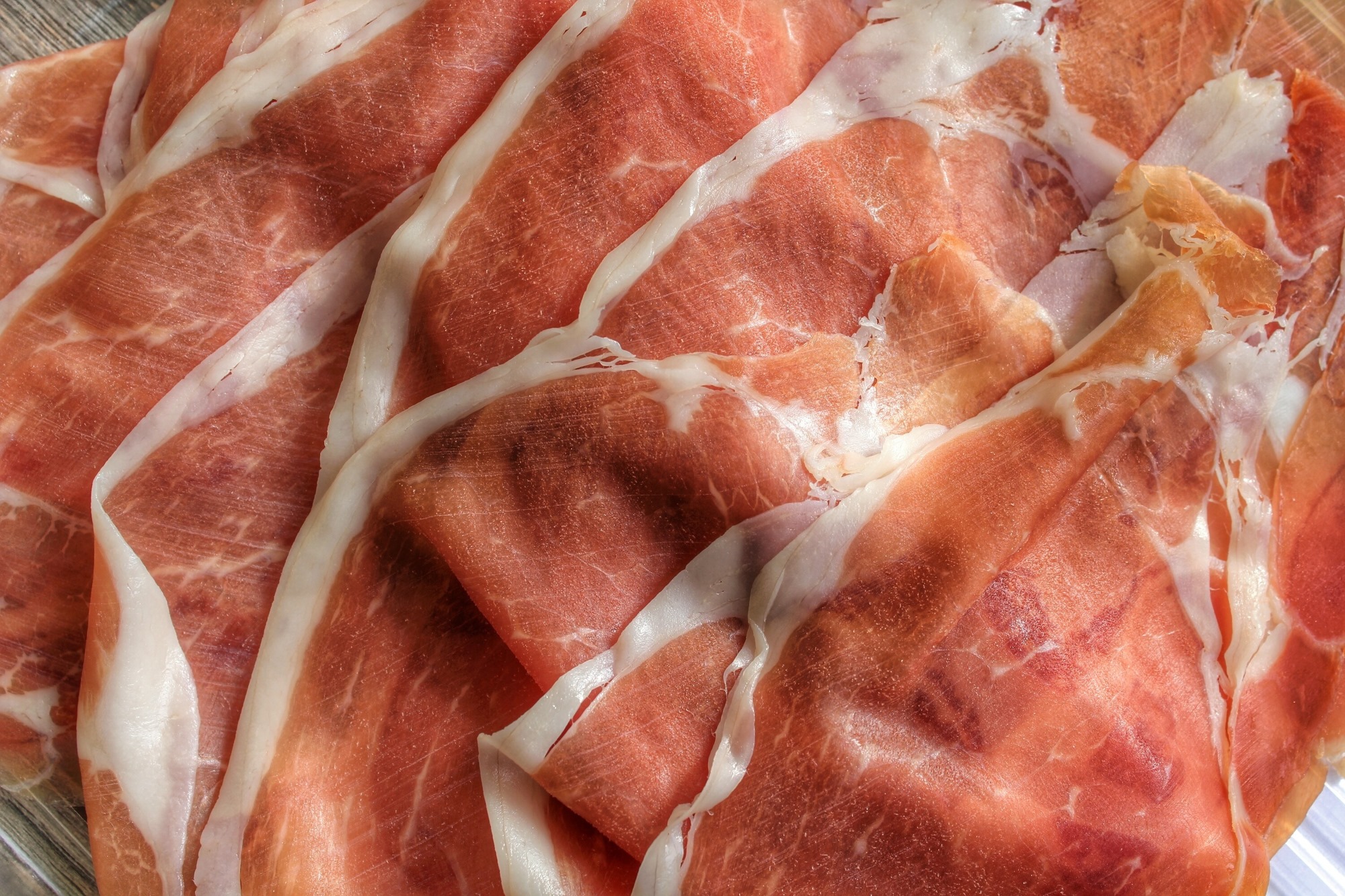
The sweetness of Parma: this is its defining trait. It comes from the combination of light salting, a specific microclimate, and natural aging. The result is a prosciutto that melts in your mouth, with a fragrant aroma and a uniform pink color streaked with white fat.
The guarantee mark: the fire-branded Ducal Crown on the rind is the only way to be certain that you have an authentic Prosciutto di Parma. If there is no crown, it is not Parma.
The perfect pairing: a slice of Prosciutto di Parma wrapped around a shard of Parmigiano Reggiano, with a glass of dry Lambrusco and — for the boldest — a few drops of ATraditional balsamic Vinegard. Four PDO products born just a few kilometers from one another: the Food Valley in a single bite.
6. Seeing Prosciutto di Parma Being Born with Food Valley Travel
Understanding Prosciutto di Parma without entering a curing facility is like understanding wine without visiting a vineyard. The sensory experience — the scent that surrounds you when you enter the aging room, the thousands of legs hanging from wooden racks, the silence broken only by the sound of windows opening — cannot be transferred into a text. It can only be lived.
Food Valley Travel takes travelers directly into the curing facilities of the traditional production area, with guides who turn a visit into a lesson in culture, history, and gastronomy. Discover all the available experiences.
→ Food Valley Gourmet Tour – The Original (Half Day) – guided visit to a Parmigiano Reggiano PDO dairy and a prosciutto curing facility, with a lunch based on local products. The classic version that combines the two kings of the Food Valley in half a day.
→ Food Valley Gourmet Tour – The Big Fives (Full Immersion Day) – a full day dedicated to the five symbolic products of the Food Valley, including prosciutto. For those who want the complete picture.
→ Parmigiano, Prosciutto & Balsamico Tour – Regular, Shared – three icons in one day, in a group version. Ideal for couples or friends who want a complete and shared experience.
→ Almost Local Parma Downtown Foodie Tour – for those who want to discover prosciutto directly in Parma’s historic food shops, hand-sliced before their eyes.
Practical tip: the best time to visit a prosciutto curing facility is spring or autumn, when the air is drier and the windows are opened more frequently. But in September, there is one more reason: the Festival del Prosciutto di Parma in Langhirano, with open visits to curing facilities, tastings, and the famous Artisti del Taglio competition.
The Ingredient You Cannot Buy
Prosciutto di Parma proves that gastronomic greatness does not come from the complexity of ingredients, but from the care with which simple ones are handled. Meat, salt, air, time. Four elements that, combined in that precise point of the Po Valley, under that precise flow of wind, with that precise dose of patience, produce something no other part of the world has ever managed to replicate.
The next time you taste a slice of Prosciutto di Parma, do not think only about the flavor. Think about the air that passed through those windows for an entire year. And if you can, go and see it in person.