

One hundred euros. Sometimes even more. For a 100 ml bottle of dark, dense liquid that, at a quick glance, might look like anything else on a supermarket shelf.
And yet, if you have ever tasted a drop of Traditional Balsamic Vinegar of Modena PDO — the real one, aged for at least 12 years in sets of progressively smaller barrels — you already know you are dealing with something completely different from that two-euro condiment in the guitar-shaped bottle found everywhere.
So what truly justifies that price? The answer lies in a single word: patience. And in a production process that cannot be rushed, automated, or truly imitated.
“Traditional Balsamic Vinegar is not produced: it is waited for. And in that waiting, it transforms into something extraordinary.”
What Traditional Balsamic Vinegar really is
First of all, let’s clarify a fundamental distinction that many people overlook — and that explains much of the confusion (and disappointment) at store counters.
Traditional Balsamic Vinegar PDO ≠ Balsamic Vinegar of Modena PGI ≠ balsamic condiment
There are three very different categories that unfortunately share similar names and sometimes misleading packaging:
- Traditional Balsamic Vinegar of Modena PDO (or Reggio Emilia PDO) is the premium product. Made exclusively from cooked grape must, aged for a minimum of 12 years (or 25 years for “Extra Vecchio”), and sold in a 100 ml bottle designed by Giorgetto Giugiaro.
- Balsamic Vinegar of Modena PGI is a blend of wine vinegar, grape must, and caramel, produced with a much faster process. Excellent for many uses, but fundamentally different.
- “Balsamic condiments” are products without any official designation, often sweetened and artificially thickened.
The price of Traditional Balsamic Vinegar is not a trend or a market whim: it is the mathematics of artisanal production.
The production process: where the value is created
It all begins with cooked must
Traditional Balsamic Vinegar is made exclusively from grape must slowly cooked over many hours until it is reduced to about one-third of its original volume. The grapes used are mainly Trebbiano and Lambrusco — local varieties grown in the specific area between Modena and Reggio Emilia.
The battery of barrels: a living ecosystem
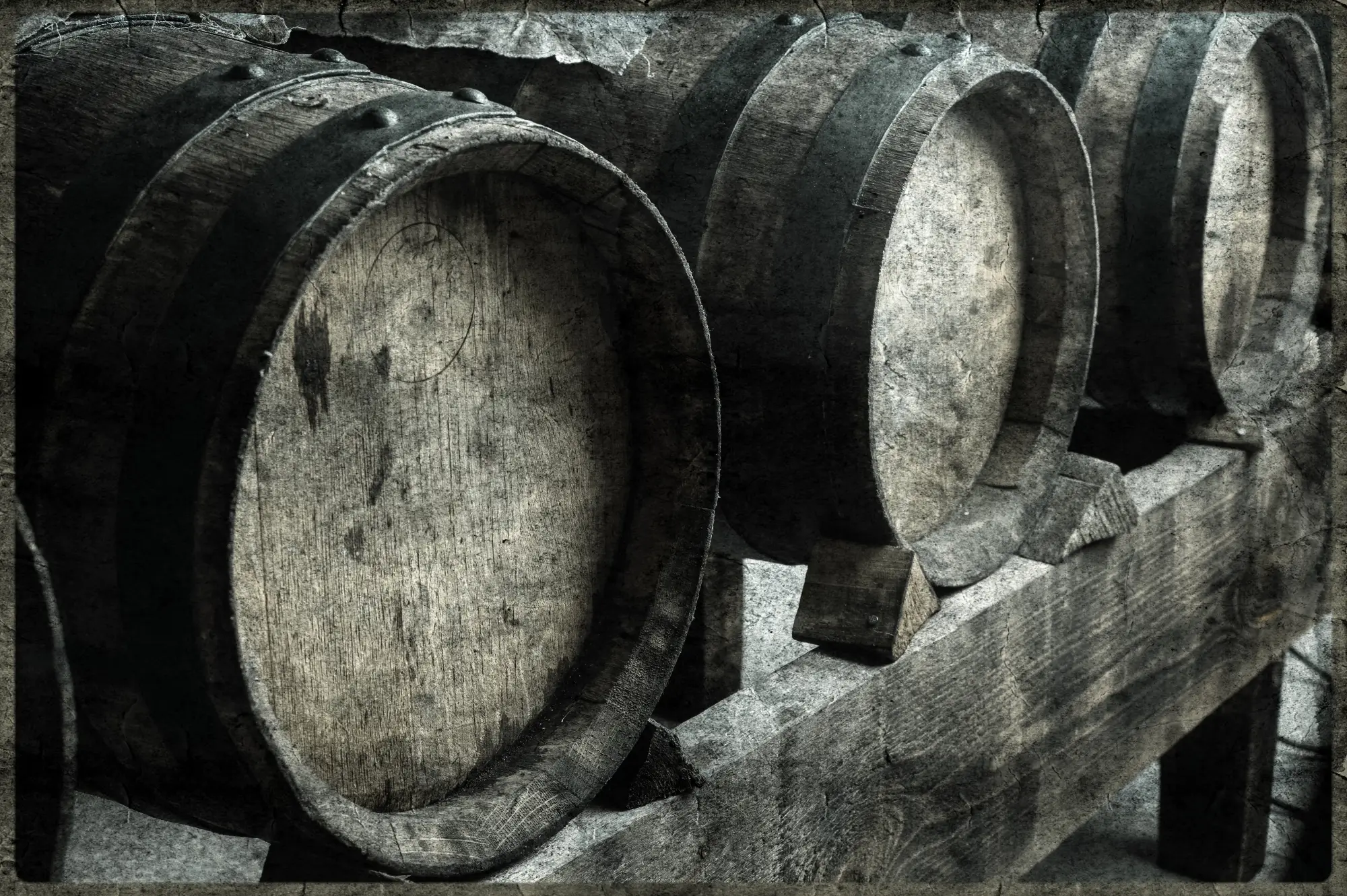
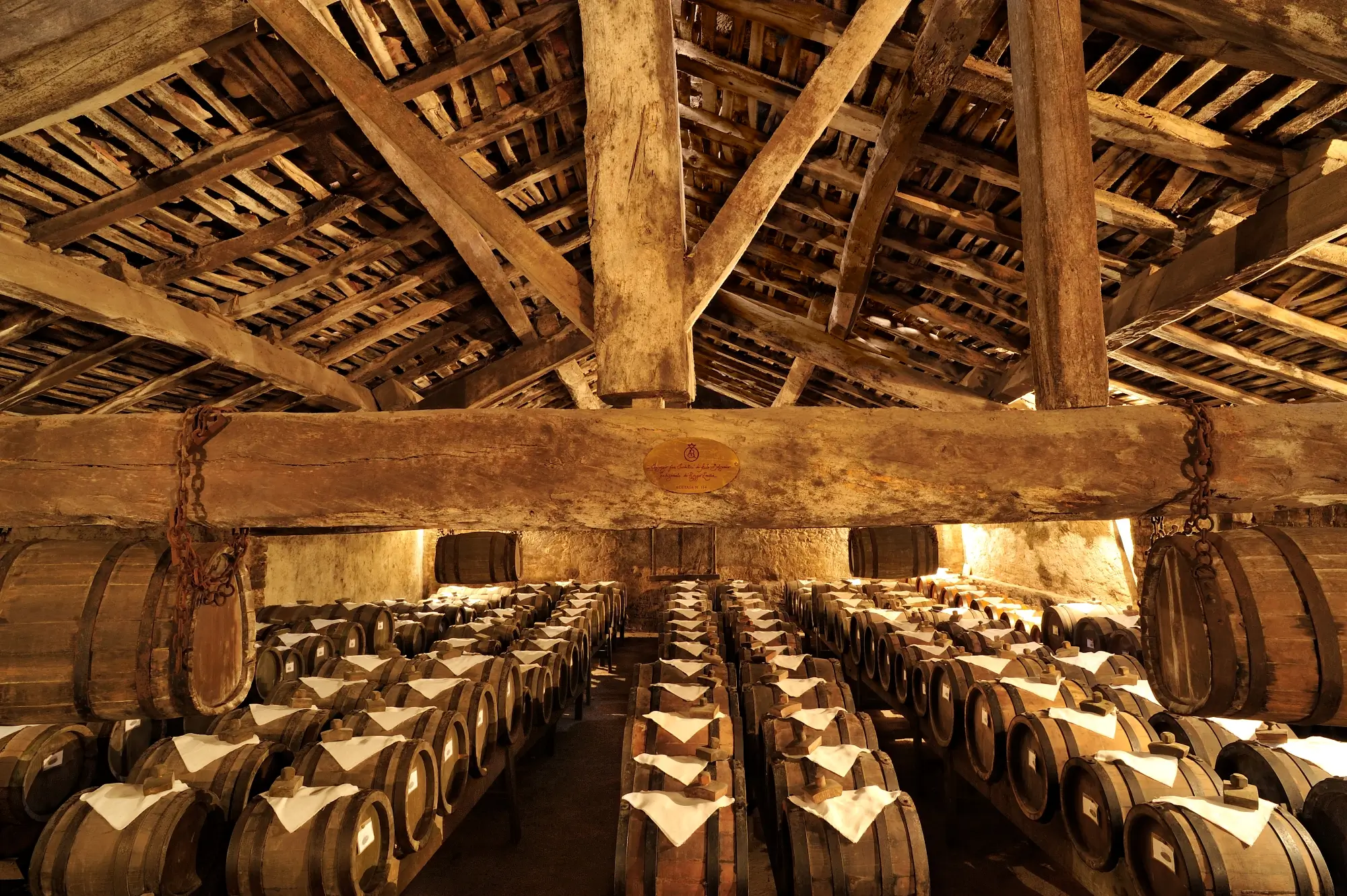
The cooked must is then poured into the first barrel of a “battery” — a series of barrels made from different woods (oak, chestnut, cherry, ash, mulberry, juniper) arranged in decreasing sizes. Each year, a small amount is drawn from the last barrel (the smallest and most concentrated) for bottling. The volume is then topped up from the previous barrel, and so on, all the way back to the first.
“A battery of barrels for Traditional Balsamic Vinegar is like a living library: each volume tells a year, and together they create something unique.”
Why it costs so much: the mathematics of patience
- From 100 kg of grapes, you obtain about 65 liters of must. After long cooking, only about 30 liters remain.
- Over 12 years of aging, the volume decreases drastically due to evaporation (the so-called “angel’s share”): up to 10% per year.
- Final result: from 100 liters of initial must, after 12 years you get only 12–15 liters of Traditional Balsamic Vinegar ready for bottling.To this you must add: the cost of barrels, the space of the attic vinegar loft (where seasonal temperature changes are essential), the annual care and monitoring, and the organoleptic and chemical analyses required by the Consortium before bottling.
The Giugiaro bottle: even the container has a story
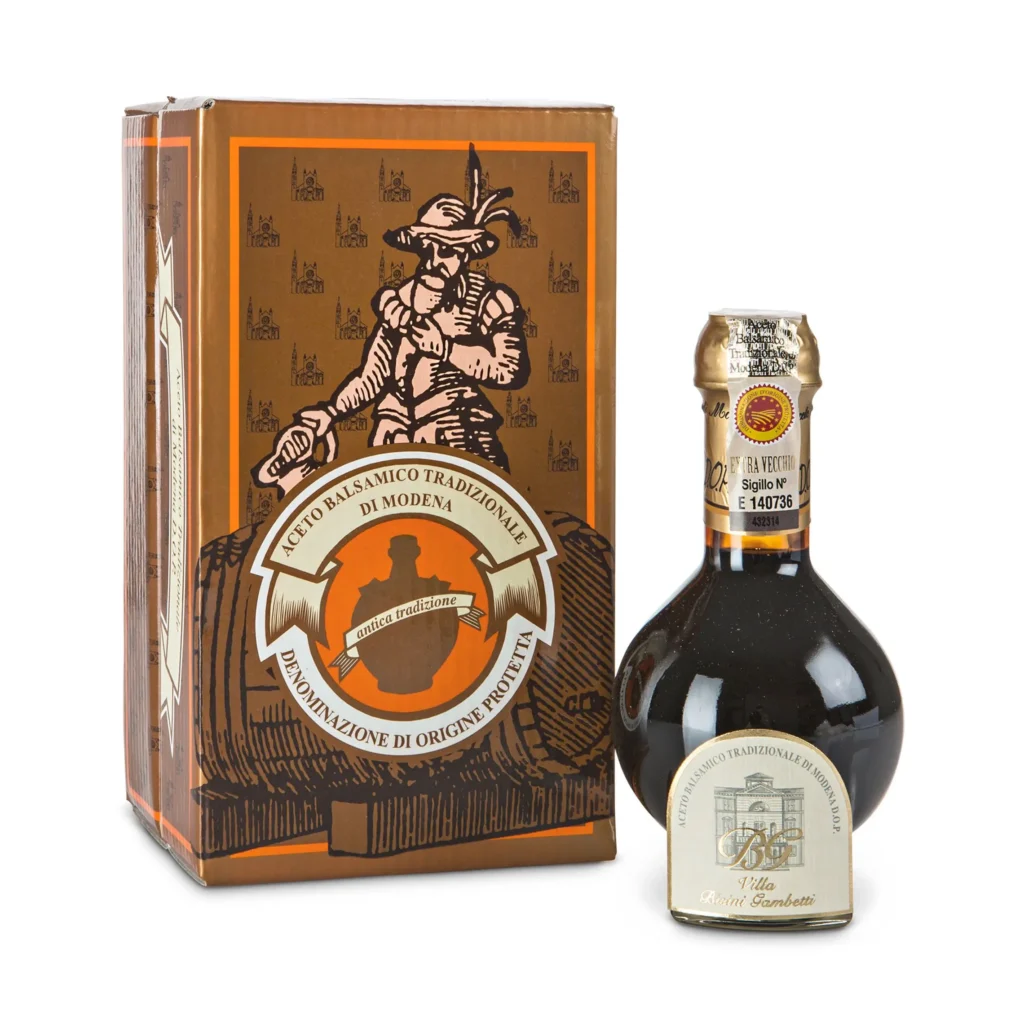
Traditional Balsamic Vinegar of Modena PDO is sold exclusively in a 100 ml bottle with a distinctive shape: spherical with a square base and a capsule cap. This packaging was designed in the 1980s by the famous designer Giorgetto Giugiaro — the same who created iconic cars like the Fiat Panda and VW Golf.
This is not just a stylistic detail: it is part of the official regulations. Each bottle is sealed with a numbered Consortium mark, guaranteeing authenticity and traceability. If you don’t see that bottle, you are not buying Traditional Balsamic Vinegar PDO.
Note: the seal color distinguishes the versions. For Modena: gold for 12 years and gold with “Extra Vecchio” for over 25 years. For Reggio Emilia: red (minimum), silver (over 18 years), gold (over 25 years).
Modena or Reggio Emilia? Comparing the two consortia
When talking about Traditional Balsamic Vinegar PDO, there are actually two distinct denominations, often confused even by experts: Modena and Reggio Emilia. Both are absolute excellences, produced with the same artisanal method and respect for time. At equal aging levels, quality is essentially equivalent: choosing one or the other is a matter of personal taste, not hierarchy.
The main differences lie in bottle design and classification systems.
- Traditional Balsamic Vinegar of Modena PDO
The bottle is the iconic spherical Giugiaro design. The classification is binary: “Tradizionale” (minimum 12 years, gold seal) and “Extra Vecchio” (over 25 years, gold seal with wording). - Traditional Balsamic Vinegar of Reggio Emilia PDO
The bottle has a more elongated, amphora-like shape. The classification has three levels, identified by label color: red (minimum aging), silver (over 18 years), and gold (over 25 years).
“The real rivalry is not between Modena and Reggio Emilia: both produce exceptional vinegar. The real distinction is between those who know the difference and those who still confuse traditional balsamic with supermarket condiments.”
From a traveler’s perspective, the most fascinating aspect is that these two denominations come from neighboring territories, sharing centuries-old traditions, the same grape varieties, and the same barrel-aging logic. Visiting a vinegar loft in both areas reveals subtle differences — like two dialects of the same language.
How to use it (and how to waste it)
Traditional Balsamic Vinegar should never be used in cooking — that would be an unforgivable waste. It is used raw, a few drops at a time, as a finishing touch on:
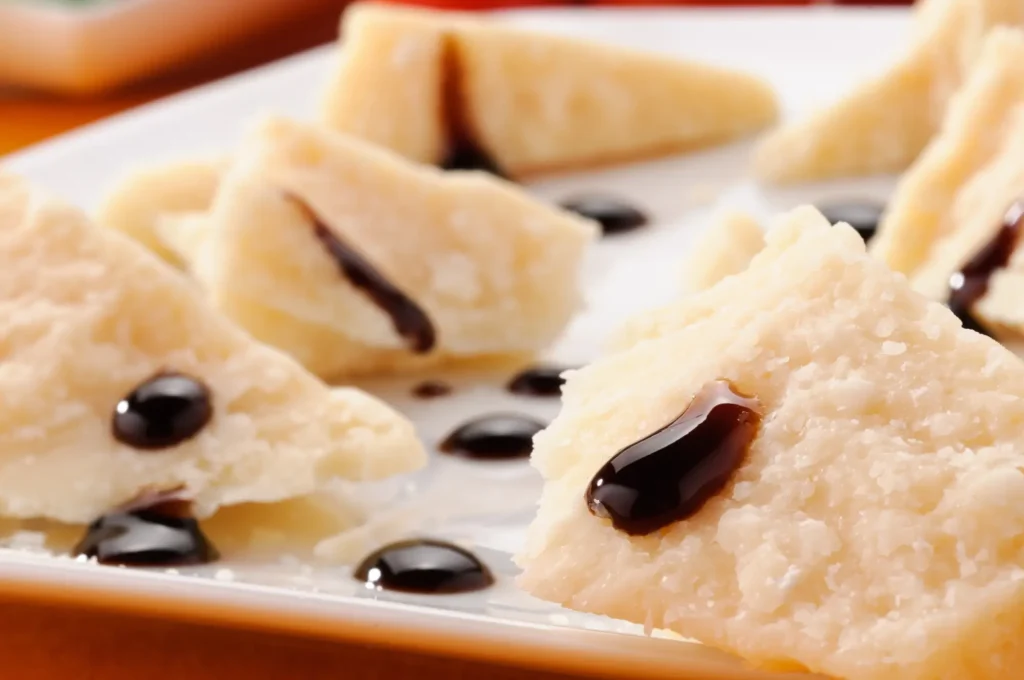
- Aged Parmigiano Reggiano flakes
- Meat or fish carpaccio
- Fresh strawberries — a classic, surprising pairing
- Risottos, just before serving
- Custard or cream gelato — an almost perfect combination
The right dose? One or two drops. No more. Its concentration and aromatic complexity require respect, not abundance.
“A drop of Extra Vecchio on a 36-month Parmigiano Reggiano flake is one of the most extraordinary gastronomic combinations in Italy — and none of those components comes from more than 50 km apart.”
Experiencing balsamic vinegar firsthand with Food Valley Travel
Knowing how Traditional Balsamic Vinegar is made is one thing. Seeing it — smelling it, tasting it directly from the barrel during a guided visit — is something entirely different. Food Valley Travel has created tailor-made experiences that bring travelers inside the vinegar lofts of the Food Valley, with expert guides who turn every detail into a compelling story.
Some experiences also include Parmigiano Reggiano, because the Food Valley is best understood as a whole:
→ Parmigiano-Reggiano & Balsamico Tour – visit a cheese factory and a traditional vinegar loft in one day.
→ Parmigiano-Reggiano, Balsamico & Lambrusco Tour – adds the dimension of local wine.
→ Parmigiano, Prosciutto & Balsamico Tour – Regular, Shared – a group experience covering three icons in one day.
→ Almost Local Modena Downtown Foodie Tour – explore Modena through its flavors with a local guide.
Practical tip: buying directly at a vinegar loft with a Food Valley Travel guide means not only spending wisely, but also receiving real-time explanations of what you are taking home. A souvenir worth every cent — and one that tells its own story at the table.
Conclusion: why it is worth every cent
Traditional Balsamic Vinegar is one of those products that changes your perception of what can be achieved with simple ingredients, time, and craftsmanship. A 100 ml bottle is not just a condiment: it is the result of years, generations, and a territory that has chosen not to rush.
The next time you see that spherical bottle with the Consortium seal, don’t ask why it costs so much. Ask how many years it took to fill it.